Faulkner was in a down-town cafe with some friends. He told them a story. “Did you ever hear the story of the shaggy dog?” he inquired. “No!” they came back. “No?” said he. “No-o,” said they.
“Well, James Fernorten wanted a shaggy dog, and—Oh! but it’s funny!” (Much laughter by Faulkner. Friends glum.)
“So he went to his friend Mike, who, he had heard, had one.
“Gee! It’s funny!!” (More laughter from Faulkner. Friends glummer.)
“But Mike’s dog, though shaggy some, was not so shaggy!” (Ha-ha-ha-he-he-ho-ho by Faulkner. Silence by friends.)
“Ain’t it funny?” he asked. “We don’t see it,” said the friends innocently. “Well, listen,”
Faulkner went on. > > “You see James Fernorten wanted a shaggy dog, and—Oh, but it’s funny!” (Much laughter by Faulkner. Friends still glum.) > > — The Cincinnati Post, January 3, 1906
My grandmother told stories the way other people breathed — constantly, effortlessly, and without any particular destination in mind. One Sunday afternoon, she launched into a tale about a neighbor’s dog that somehow wound through three decades, two failed marriages, and a church bake sale dispute, only to end with the observation that the dog “wasn’t even that big, really.” We all sat there blinking. She laughed until she cried. I was maybe twelve, and I remember thinking: what just happened? Years later, sitting in a university folklore seminar, a professor scrawled two words on the whiteboard — “shaggy dog” — and suddenly my grandmother’s living room came flooding back. That was the moment I understood that her rambling, pointless, magnificent stories had an actual name, a documented history, and roots far deeper than anyone in my family had ever imagined. That realization sent me down a research rabbit hole I still haven’t fully climbed out of.

So what exactly is a shaggy dog story? And where did the term come from? The answers turn out to be surprisingly specific — and delightfully ironic, given the genre’s reputation for going nowhere fast.
What Makes a Story a “Shaggy Dog Story”
Before tracing the origin, it helps to nail down the definition. A shaggy dog story follows a recognizable pattern. It builds slowly, accumulating detail after unnecessary detail. It creates genuine suspense or anticipation. Then, at the critical moment, it delivers an anticlimax so deflating — or a punchline so weak — that the listener feels almost personally betrayed.
Linguists and folklorists have studied this structure carefully. The genre weaponizes the listener’s own investment against them. You lean in. You follow the thread. Then the storyteller yanks it away and laughs at your expectation.
Mary and William Morris captured this perfectly in their 1977 Morris Dictionary of Word and Phrase Origins:
shaggy dog story is one that starts with a fairly improbable premise, builds suspense for a long time, adding detail upon detail, only to evaporate with a final throwaway anticlimax.
That definition, however, came more than seventy years after the earliest traceable version of the story itself. The journey from that first tale to this crisp definition covers decades of newspaper columns, banker pranks, transatlantic dog journeys, and one very unfortunate man in Cincinnati.
The 1906 Cincinnati Origin: Two Stories in One
Researchers tracing the phrase’s origin have identified The Cincinnati Post of January 3, 1906 as the earliest known source. What makes this source fascinating is its structure. It actually contains two shaggy dog stories nested together — and that layering is part of what made it so memorable.
The first story belongs to P. J. Faulkner, a man who apparently found his own pointless tale hilarious. He cornered friends in a downtown café and told them about a man named James Fernorten who wanted a shaggy dog. The punchline, such as it was, amounted to nothing more than the observation that the dog he found was “not so shaggy.” Faulkner roared. His friends stared.

His friends, however, got creative. They placed a newspaper advertisement — carefully worded to echo the absurdity of Faulkner’s story — seeking a shaggy dog “but not too shaggy.” The response overwhelmed Faulkner’s home:
Dogs big, dogs small, dogs mangy, dogs shaggy, dogs hairless, sightless and lame; dogs white, dogs black, dogs brown and dogs spotted, dingy and faded; dogs fat, dogs lean, dogs barking and dogs with tin cans tied to tails—dogs, dogs, DOGS. They came to his house all day.
The journalist who wrote the piece essentially told a second shaggy dog story about the first one. Over time, readers and retellers collapsed both stories into a single narrative. The dual structure dissolved, but the essential DNA — the advertisement, the dog, the crushing anticlimax — survived and replicated.
The Story Travels: 1908 and the Brooklyn Version
By 1908, the tale had migrated significantly. The New York Morning Telegraph published a version that stripped away Faulkner entirely and replaced him with a more sympathetic protagonist — a broke man in Brooklyn with only a nickel to his name.
This version added genuine pathos. The man and his beloved dog walk all the way from Brooklyn to Harlem — a genuinely exhausting journey — because he spotted a newspaper ad seeking a shaggy dog. He rings the bell. He waits nervously. The advertiser finally appears, glances at the dog, and delivers the verdict:
“‘Tain’t shaggy enough.”
And the advertiser turned away.
This version spread widely. The story resonated because it balanced comedy with cruelty in a way the Faulkner original didn’t quite achieve. The listener laughs — then immediately feels slightly guilty for laughing.
The Banker’s Prank: W. Buck Taylor in 1911
Five years later, a remarkably similar situation played out in St. Louis. The Fort Worth Star-Telegram reported in 1911 that W. Buck Taylor of Boatmen’s Bank had developed an identical obsession to Faulkner’s. Taylor told the same pointless story over and over while his colleagues endured it with “mirthless laughter.”
His colleagues retaliated identically to Faulkner’s friends — they ran a newspaper advertisement in Taylor’s name, requesting a shaggy dog be returned to him at his hotel. Dogs arrived. Chaos followed. The pranksters celebrated.
This parallel episode suggests something important. The shaggy dog story wasn’t just a tale being passed around — it was a type of behavior that multiple people independently exhibited and that provoked identical social responses. The story and the prank it inspired formed a kind of cultural unit, replicating itself across cities and decades.

The Phrase Itself Appears: 1918
The actual phrase “shaggy dog story” surfaced in print in 1918. A theater columnist named Emory B. Calvert used it almost casually, as a parenthetical aside:
(Note—Shaggy dog story will be mailed on application to editor.)
That throwaway reference implies the phrase already carried enough cultural weight that readers would understand it without explanation. Calvert didn’t define it. He simply deployed it, confident his audience would follow. That kind of casual usage typically signals that a phrase has been circulating in spoken language for some time before it appears in print.
Bennett Cerf and the Transatlantic Version: 1943
By the early 1940s, the shaggy dog story had gone international — literally. Publisher and humorist Bennett Cerf offered a definition and a canonical version in The Saturday Review in April 1943.
Cerf’s version introduced the transatlantic journey that would become a staple of the genre. A Kansas City man finds a London Times advertisement seeking a very shaggy dog. He locates an impressively shaggy pup and travels all the way to England. He reaches the door. He presents the dog. The lady who placed the ad looks at the animal and snaps:
“Heavens, no. It wasn’t that shaggy” — and slammed the door in his face.
Cerf’s version amplified the absurdity by making the journey intercontinental. The greater the investment, the more devastating the dismissal. This scaling-up became a defining feature of the genre’s evolution — storytellers kept raising the stakes of the journey while keeping the punchline equally deflating.
Eric Partridge Tries to Pin It Down: 1953
In 1953, lexicographer Eric Partridge published a book devoted entirely to the subject: The Shaggy Dog Story. Partridge suggested the story arose from a tale “widely circulated only since 1942 or 1943, although it was apparently invented in the 1930s.”
His version featured a Park Lane householder who loses a valuable shaggy dog, advertises repeatedly in The Times, and eventually gives up hope. A New Yorker finds the dog and makes the journey to England. At the door, the butler delivers the verdict with magnificent horror:
“But not so shaggy as that, sir!”
Partridge’s dating was off — the narrative clearly predates the 1930s by several decades, as the 1906 Cincinnati evidence demonstrates. However, his book performed an important cultural function. It legitimized the shaggy dog story as a genre worth studying, named it formally, and gave it a place in the reference literature.
The Morris Dictionary Version: 1977
By 1977, the shaggy dog story had evolved into something almost mythological. Mary and William Morris presented a version in their Morris Dictionary of Word and Phrase Origins that escalated the premise to operatic proportions.
In this telling, a wealthy titled lord places an advertisement in The Times of London offering five thousand pounds — plus travel expenses — for “the shaggiest dog in the world.” The winning candidate surfaces in Australia. The dog and its owner travel by ship to England. Thousands of people greet them. They ride a cab to the nobleman’s address, mount the steps, pass a footman, pass a butler, and enter a grand drawing room:
As thousands cheered, they mounted the steps, were greeted by a footman, then ushered by a butler into a drawing room, where the man and shaggy dog waited before the fireplace. After a moment, the lord of the manor appeared, took one look at the dog, and said: “I don’t think he’s so shaggy.”
This version represents the genre at its most refined. The journey spans continents. The crowd cheers. The stakes reach five thousand pounds. And the dismissal remains exactly as flat and casual as every version before it. That contrast — maximum investment, minimum payoff — crystallizes everything the shaggy dog story has always been about.
Why the Punchline Never Changes
Across more than a century of variations, one element stays constant: the dismissal always concerns the dog’s shagginess. “Not so shaggy.” “‘Tain’t shaggy enough.” “He wasn’t so shaggy.” “But not so shaggy as that, sir!” The specific wording shifts, but the structure holds.
This consistency reveals something important about the genre’s mechanics. The shaggy dog story doesn’t just tell a joke — it performs a critique of jokes. It asks: what happens when the punchline is the absence of a punchline? What happens when the story promises resolution and delivers only a shrug?
The listener’s frustration becomes the point. The joke is on anyone who expected a joke.
The Genre Expands Beyond Dogs
Over the twentieth century, the shaggy dog story outgrew its canine origins. Source The term came to describe any long, rambling narrative that ends with an anticlimactic or groan-worthy punchline — regardless of whether any dogs appear.
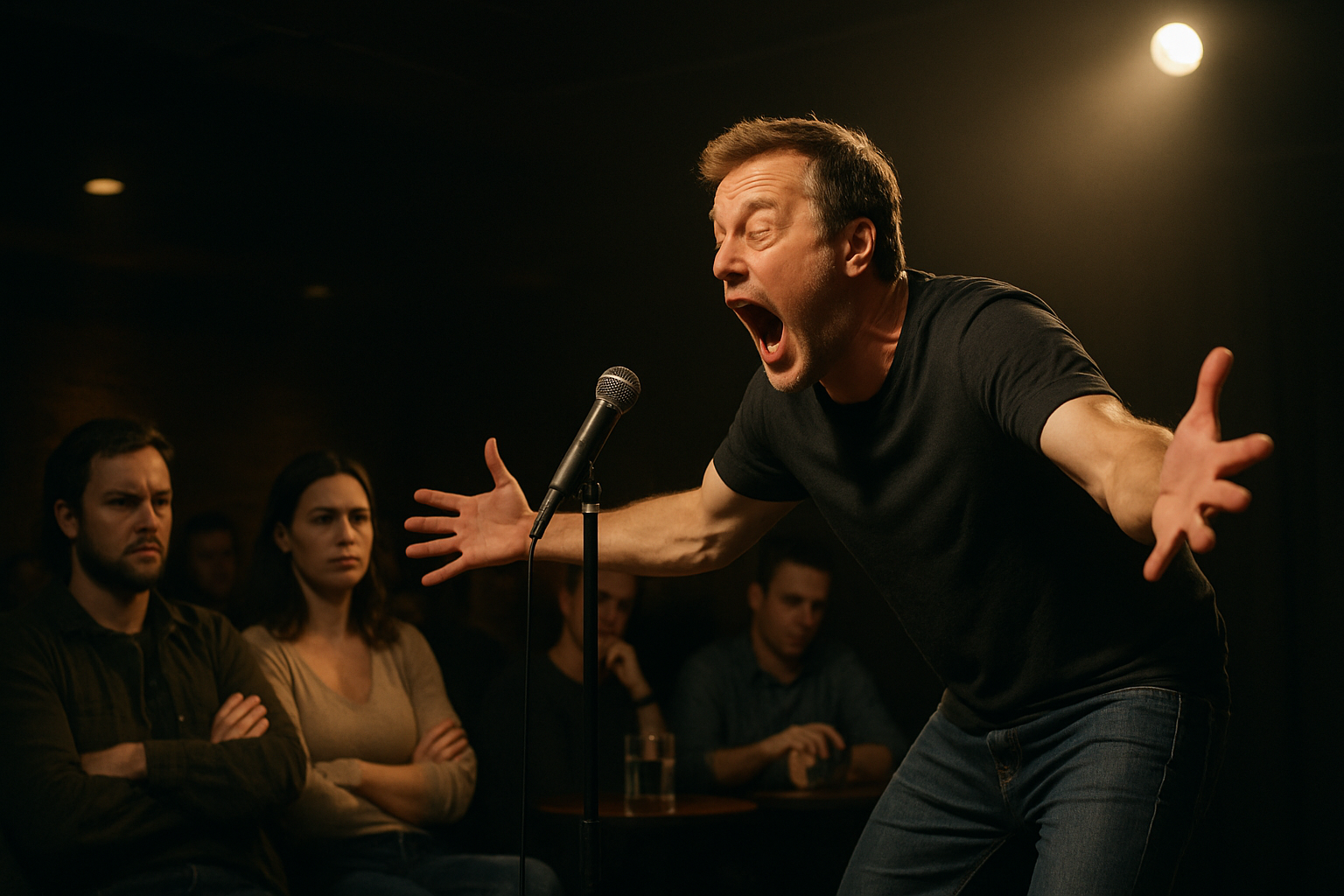
Comedians, writers, and raconteurs adopted the form enthusiastically. The shaggy dog story became a test of a storyteller’s nerve — could you hold an audience through ten minutes of apparently pointless detail, trusting that the final deflation would land? The best practitioners made the frustration itself funny. The worst simply annoyed people, which, ironically, was also sort of the point.
Modern stand-up comedy still deploys the form regularly. Source Long-form podcasts have revived it. Certain novelists — particularly in the postmodern tradition — have built entire books around the shaggy dog principle of promising meaning and delivering beautiful, deliberate meaninglessness.
The Misattribution Problem
Because the shaggy dog story evolved through oral tradition and anonymous newspaper reprinting, attribution has always been messy. Various versions credit different originators — P. J. Faulkner, W. Buck Taylor, Bennett Cerf, Eric Partridge, and countless unnamed journalists all appear in the lineage. None of them invented the form outright. Each contributed to its evolution.
This collective, anonymous authorship is itself fitting. Source A story about pointlessness probably shouldn’t have a single, authoritative origin. The shaggy dog story resists the tidy narrative arc that would give it a clean beginning, middle, and end. It sprawls. It accumulates. It refuses to resolve neatly.
Even the earliest documented version — the 1906 Cincinnati piece — contains two stories, not one. The origin is already doubled, already tangled. That feels exactly right.
What the Shaggy Dog Story Teaches Us
There’s a reason this genre has survived for well over a century. The shaggy dog story taps into something fundamental about how we process narrative. We are, as a species, deeply invested in stories reaching their destinations. We follow threads. We track setups. We wait for payoffs.
The shaggy dog story exploits that investment ruthlessly. It trains you to expect resolution, then yanks the rug out. And here’s the strange thing: we keep falling for it. Even people who know the genre — who have heard dozens of shaggy dog stories — still lean in. Still follow the thread. Still feel that small, absurd pang when the punchline fails to arrive.
Maybe that’s why my grandmother laughed so hard. She wasn’t just telling a pointless story. She was demonstrating something true about storytelling itself — that the journey matters more than the destination, and that sometimes the destination is simply the realization that there was never going to be one.
From a Cincinnati café in 1906 to transatlantic dog journeys and Victorian drawing rooms, the shaggy dog story has carried that lesson across generations. The details keep changing. The dismissal stays the same. And somehow, every single time, we’re still surprised.
That, perhaps, is the shaggiest joke of all.