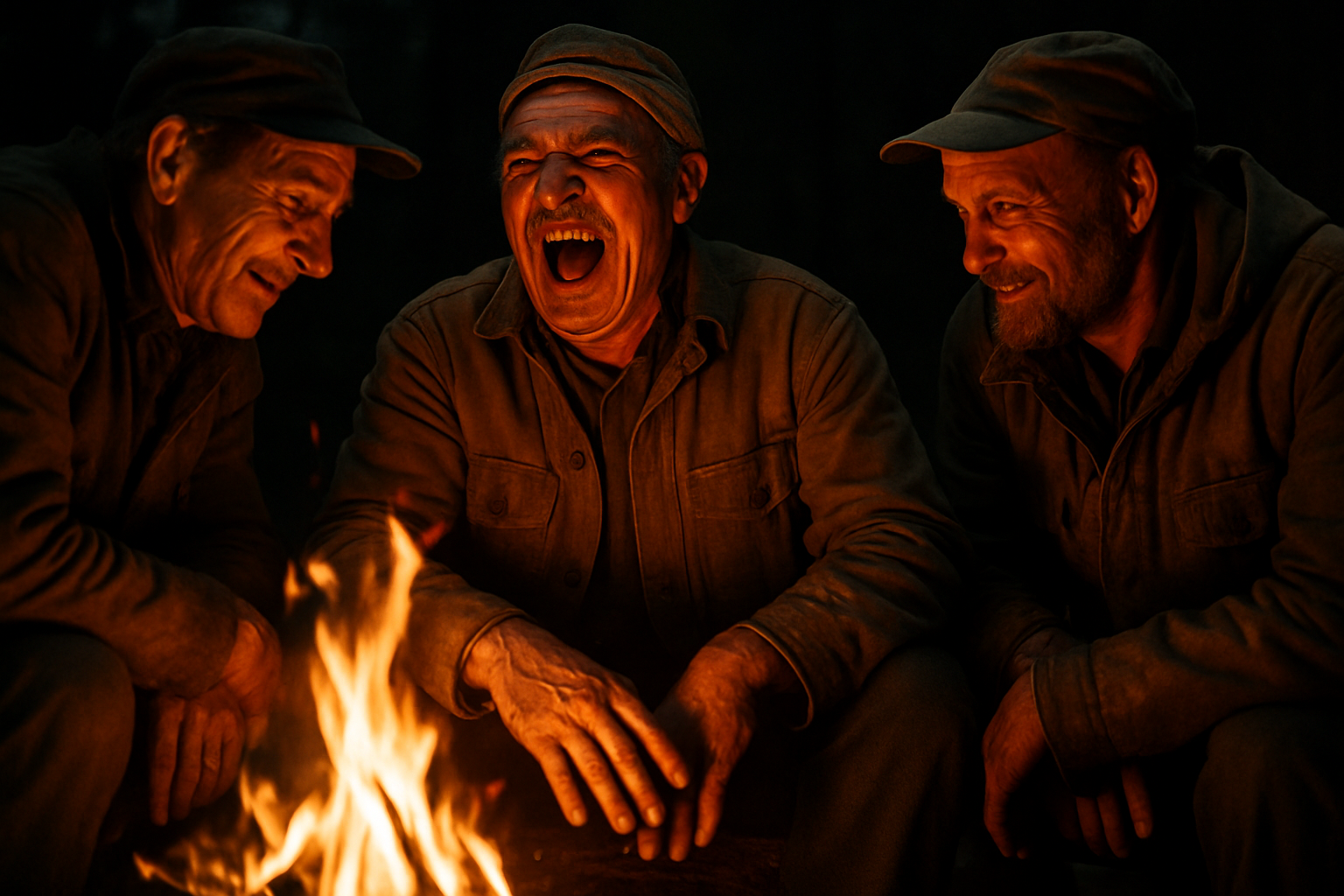
‘Twas a dark and fearsome night. Brigands great and brigands small were gathered around the camp fire. “Come, Antonio,” they called to the terrible chief, “tell us one of your famous stories.”
And Antonio arose and said: > > “‘Twas a dark and fearsome night. Brigands great and brigands small were gathered around the camp fire. ‘Come, Antonio,’ they called to the terrible chief, ‘Tell us one of your famous stories.’ And Antonio arose and said: > > “‘Twas a dark and fearsome,” etc., etc., indefinitely.
I first encountered this story not in a book or a classroom, but in a moment of genuine frustration. A colleague of mine — a literature professor who collected odd verbal curiosities the way others collect stamps — leaned across a seminar table one afternoon and asked if I knew “the Antonio story.” I didn’t. He began reciting it with theatrical gravity, and by the third nested repetition, the entire room had dissolved into laughter. What struck me wasn’t just the humor. It was the realization that someone, over a century ago, had deliberately built a story designed to go nowhere — and that this deliberate nowhere-ness was the entire point. That afternoon planted a question I couldn’t shake: where did this strange, looping tale actually come from? The answer, it turns out, winds through vaudeville stages, newspaper columns, folklore journals, and campfire circles across America.
—
The Recursive Tale That Refuses to End
The story of Antonio and his famous tales belongs to a peculiar literary category. Scholars call it a “circular formula tale” — a narrative that folds back on itself endlessly. The joke, such as it is, never resolves. Antonio always begins his story. The brigands always listen. And then Antonio begins again.
This structure is deceptively sophisticated. Modern readers might recognize it as an early form of metafiction — storytelling that comments on the act of storytelling itself. However, the Antonio tale predates those theoretical frameworks by decades. Someone, somewhere around the turn of the twentieth century, built this recursive joke without any academic scaffolding — just a sharp comic instinct and a campfire full of brigands.
The Earliest Known Appearance: Buffalo, 1900
The trail begins in Buffalo, New York. In January 1900, the Buffalo Evening News published a political commentary that referenced the Antonio story — not by telling it outright, but by invoking it as a shared cultural touchstone. The writer compared a military figure to Antonio, imagining him seated around a fire with “brigands great and brigands small,” promising famous victories that never quite materialize.
This reference matters enormously. When a newspaper uses an allusion without explaining it, that signals the audience already knows the source. Therefore, the Antonio story must have circulated before January 1900. How much earlier remains unclear. Additionally, a second Buffalo newspaper — the Buffalo Times — referenced similar imagery just months later in March 1900. Two separate Buffalo papers invoking the same tale within months strongly suggests the story had already achieved regional, if not national, familiarity.
The exact origin point, however, remains frustratingly elusive. No single author has ever claimed clear, documented credit for inventing the Antonio tale.
Canfield and Carlton: The Vaudeville Connection
The strongest lead points to a vaudeville duo. In March 1902, the Indianapolis Journal reviewed a performance at the Grand Theatre and described a comedy team called Canfield and Carlton. Their act included a bit where the male performer launched into the Antonio story — repeating it with increasing absurdity while stagehands scrambled behind the scenes.
The review captures something wonderful about how the bit worked in practice. The performer kept looping through the tale, and eventually the theater’s property man physically dragged him offstage. Even then, the performer kept shouting about Antonio from behind the curtain — voice muffled, as though someone had pressed a carpet over his head.

This staging tells us something important. The Antonio story wasn’t just a joke someone told at a party. Canfield and Carlton built an entire physical comedy routine around it. They used the recursive loop as a deliberate stalling device — stretching their act while stagehands set up equipment for the next performance. The infinite loop, in other words, served a practical theatrical purpose.
Whether Canfield and Carlton invented the tale or simply popularized it remains genuinely uncertain. They may have picked it up from oral tradition and refined it for the stage. Alternatively, they may have created it whole cloth and watched it escape into the broader culture. Either scenario fits the evidence.
How the Story Spread: Newspapers and Word of Mouth
By 1910, the Antonio tale had traveled far beyond Indiana. The Plattsmouth Journal in Nebraska printed a version that year, describing it as a “childish rigmarole” that “goes on in an unending circle.” Notably, this version substituted “dark and stormy” for “dark and fearsome” — a small variation that hints at the story’s oral transmission. Stories change as they travel. Each teller adjusts details slightly, and gradually variants multiply.
The Nebraska version also contains an endearing grammatical slip: “We never known Antonio’s story.” This small error feels deeply human. Someone transcribed the tale as they heard it spoken, capturing the colloquial rhythm of oral storytelling rather than polished written prose.
Meanwhile, the story kept circulating through performance culture. In 1922, the Chicago Tribune’s popular column “In the Wake of the News” revisited the Canfield and Carlton routine with evident nostalgia. The columnist prefaced the memory with “Do you remember way back when?” — suggesting that by the 1920s, the Antonio tale already carried the warm glow of a shared cultural past.
Folklore Scholars Take Notice
The Antonio tale eventually attracted serious academic attention. In 1952, William L. Alderson of Reed College published a short piece in the journal Western Folklore titled “Two Circular Formula Tales.” Alderson noted that his own family members recited a version set on the Susquehanna River, with a band of robbers rather than brigands.
This family transmission detail is significant. By 1952, the story had clearly moved beyond vaudeville stages and newspaper columns into domestic oral tradition. Parents told it to children. Children told it to friends. The tale had achieved that rare folkloric status — it belonged to everyone and no one simultaneously.
Two years later, in 1954, Western Folklore published additional testimony from Olwyn Orde Browne, who had heard the tale from neighborhood children in Los Angeles. This version introduced a second character — Bartholomew — who alternates with Antonio in demanding and then telling the endless story. The Bartholomew variant adds another layer of recursion: not only does the story repeat, but the storytelling roles themselves rotate in an infinite exchange.
Variations Across Time: The Story’s Many Faces
One of the most striking aspects of the Antonio tale is how consistently its core structure survives despite surface variation. The setting shifts — sometimes a campfire, sometimes the Susquehanna River. The characters change — Antonio alone, or Antonio and Bartholomew, or unnamed robbers and captains. The opening phrase mutates between “dark and fearsome,” “dark and stormy,” and “dark and dismal.”
However, the essential mechanism never changes. Someone always asks for a story. Someone always begins telling it. And that story always begins with the same dark night and the same request. The loop is inescapable — that’s precisely the point.
In 1987, a Vermont newspaper column published a reader’s letter recalling the tale from her childhood. The reader, named Peggy, remembered hearing it from her mother — meaning the story had passed through at least two generations of oral transmission by that point. Peggy’s version used “ad infinitum” to signal the loop’s endless nature, suggesting her family’s telling had a slightly more literary flavor than the vaudeville original.

Why This Story Endures: The Psychology of the Loop
So why does this tale keep resurfacing across decades and contexts? The answer lies in what the loop actually does to a listener. Initially, the repetition feels like a setup — surely the real story is coming. Then comes the dawning realization that the repetition is the story. Finally, there’s the absurd delight of recognizing that Antonio will never, ever tell his famous tale.
This structure exploits a fundamental feature of human cognition. We crave narrative resolution. The Antonio tale deliberately withholds that resolution forever. As a result, the frustration becomes the humor. The joke isn’t a punchline — it’s a trap, and the listener walks into it willingly every time.
Additionally, the story works across wildly different contexts. Vaudeville performers used it to stall for time. Families told it around dinner tables. Children shared it in schoolyards. Each context reframes the same recursive structure as something slightly different — a performance piece, a family ritual, a playground game. This adaptability explains the tale’s remarkable longevity.
Attribution: The Honest Answer
Who actually created the Antonio tale? Canfield and Carlton remain the strongest candidates, given the 1902 documentation of their act. However, the January 1900 Buffalo newspaper references suggest the story circulated before their documented performances. Therefore, the duo may have popularized rather than invented the tale.
The honest answer is that we don’t know. Source The Antonio story may have emerged from anonymous oral tradition — the kind of communal creative process that produces folk songs, ghost stories, and playground rhymes. Alternatively, a single witty person may have coined it in the 1890s, and that person’s name simply never attached itself to the tale as it spread.
This uncertainty is itself part of the story’s character. Antonio never tells his famous tale. And the person who first invented Antonio remains equally elusive — always just out of reach, always about to be identified, always beginning again.
The Deeper Literary Significance
Beyond its comic value, the Antonio tale represents something genuinely interesting in the history of narrative form. Source It demonstrates that recursive, self-referential storytelling isn’t a twentieth-century invention. Long before academic theorists coined terms like “metafiction” or “mise en abyme,” ordinary performers and storytellers were playing with the idea that a story could fold back on itself and comment on its own telling.
In this sense, the Antonio tale deserves more recognition than it typically receives. It isn’t merely a joke. It’s a tiny, perfectly constructed machine for exploring what stories are — and what happens when they refuse to be stories at all.
Conclusion: Antonio Still Hasn’t Finished
The tale of Antonio and the brigands has now circulated for well over a century. It passed from vaudeville stages to newspaper columns, from folklore journals to family dinner tables, from one generation of children to the next. Along the way, it shed its original context entirely. Most people who know the story today have no idea it once helped a comedy duo fill time while stagehands built a bicycle track offstage.
What survives is the loop itself — clean, irresistible, and permanent. Source ‘Twas a dark and fearsome night. The brigands gathered. Antonio arose. And Antonio will keep arising, indefinitely, in the memories of everyone who has ever heard this strange little tale and found themselves laughing at the beautiful, infuriating fact that it never, ever ends.
Somewhere out there, Antonio is still talking.