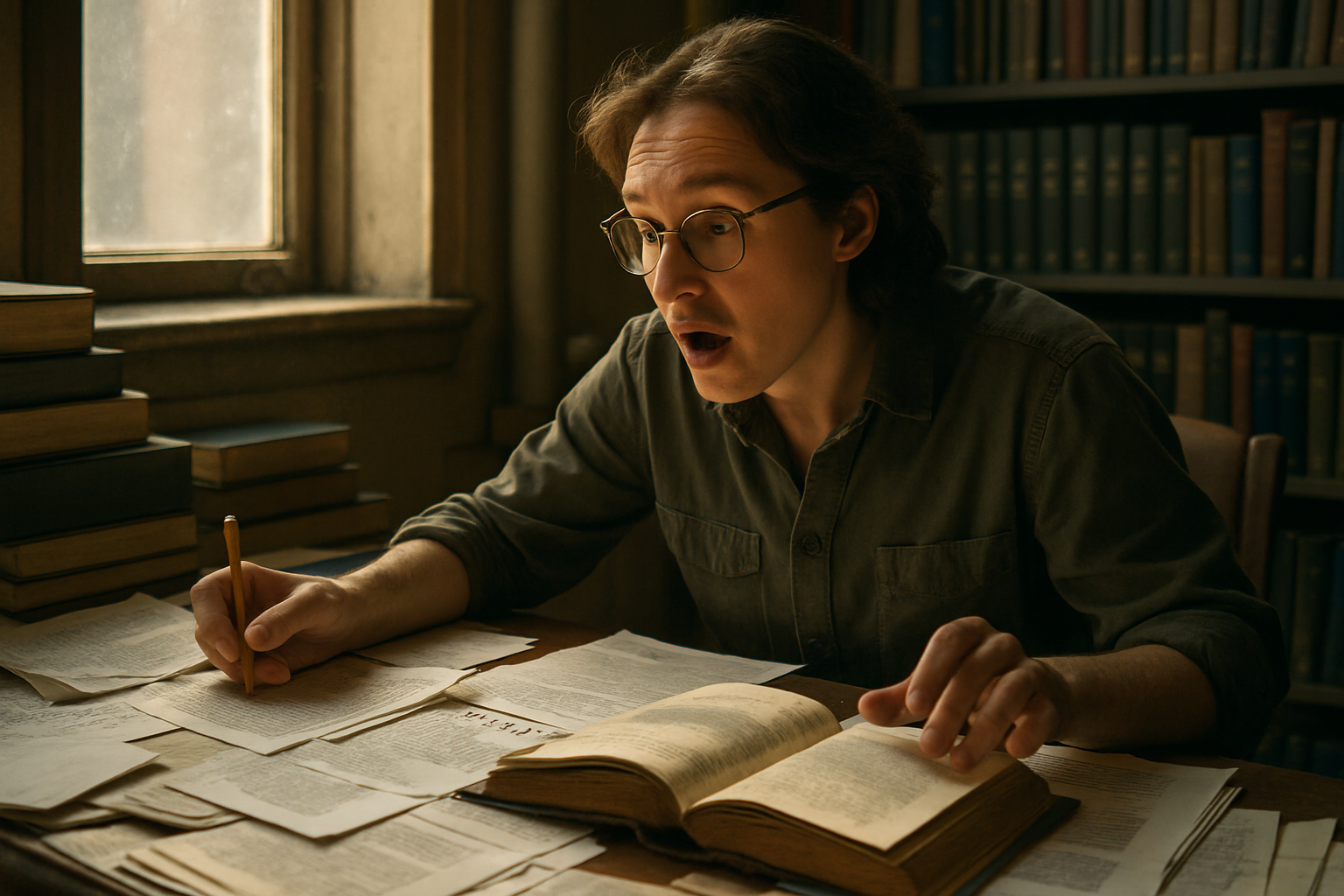
We first make our habits, and then our habits make us. I first encountered this quote during one of the worst professional stretches of my life. A mentor slid a handwritten note across a coffee shop table — no preamble, no explanation, just those fourteen words scrawled in blue ink. I almost dismissed it as motivational poster fodder. However, something about the phrasing stopped me cold, because it wasn’t telling me to try harder — it was telling me I had already been building something, whether I noticed or not. The note sat on my desk for weeks. Eventually, I realized I wasn’t just reading a quote anymore — I was reading a diagnosis of exactly how I’d arrived at that difficult moment. That shift in understanding sent me deep into the quote’s actual history, and what I found was far more fascinating than I expected. [image: A researcher in their late 30s sits hunched over a cluttered wooden desk in a dimly lit university archive room, natural afternoon light filtering through a dusty window to their left, caught in a completely unguarded moment — mouth slightly open, eyebrows raised in genuine surprise, one hand frozen mid-reach toward an open aged book while the other grips a pencil loosely, a scattered mess of photocopied historical documents and handwritten notes spread across the surface around them, the expression unmistakably that of someone who has just discovered something unexpected, candid and unposed, shot from a slight side angle as if the photographer quietly entered the room without disturbing them, warm ambient light mixing with the cool window light to cast soft shadows across the stacks of reference materials.] The Quote That Everyone Knows and Nobody Can Source Few sayings travel as confidently through the world as this one. You find it in productivity books, leadership seminars, therapy worksheets, and Instagram carousels. People cite it with authority. Coaches build entire frameworks around it. Yet when you pull on the thread of its origin, the whole neat story starts to unravel. The attribution most commonly attached to it — John Dryden, the celebrated English poet — turns out to rest on surprisingly shaky ground. Understanding why this matters requires a short journey through centuries of quotation collections, religious writing, newspaper columns, and the very human habit of repeating things without checking them first. What John Dryden Actually Wrote About Habits John Dryden died in 1700, leaving behind an enormous body of work — plays, translations, satires, and poems that shaped the English literary tradition. He genuinely did write about habits, and his words on the subject carry real power. In a 1700 collection titled Fables Ancient and Modern, Dryden translated Ovid’s Metamorphoses and included these lines: > Ill Habits gather by unseen degrees,
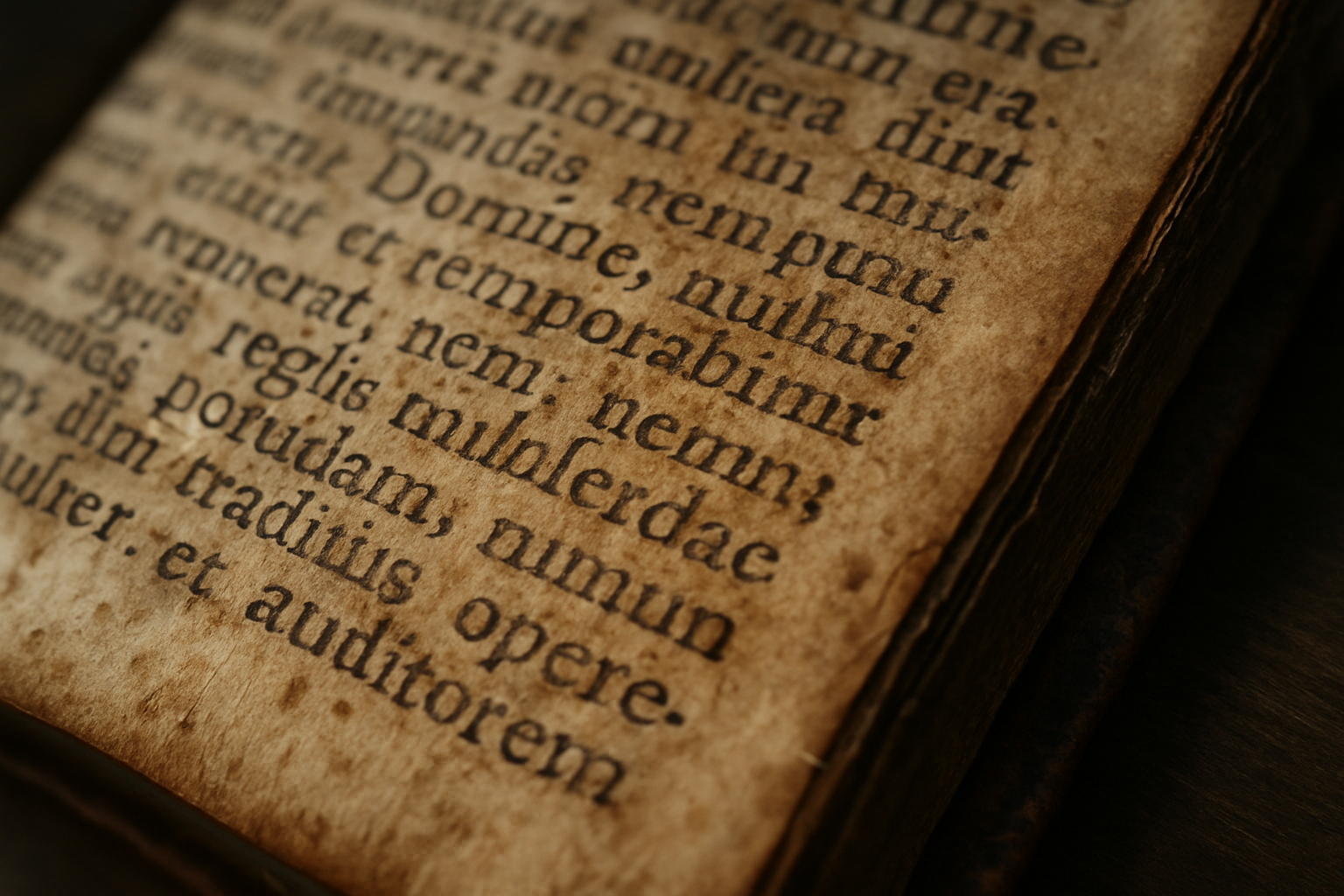
As Brooks make Rivers, Rivers run to Seas. Those lines are vivid, memorable, and entirely Dryden’s. However, notice what they don’t say. They describe how bad habits accumulate quietly — they don’t describe the reciprocal relationship between a person and their habits. The famous modern quote carries a different, more dynamic idea: that we shape our habits, and then our habits shape us back. Dryden’s couplet captures accumulation. The famous quote captures transformation. These are meaningfully different claims. So how did Dryden’s name end up attached to a quote he almost certainly never wrote? The 1891 Quotation Collection That Started the Confusion [image: Close-up photograph of a weathered, yellowed page from a 17th-century leather-bound book, filling the entire frame with aged parchment texture — the surface crinkled and foxed with brown age spots, the paper fibers visible under raking natural light from a nearby window. The ink on the page has faded to a warm sepia, the letterpress type slightly embossed into the fragile sheet, edges of the page softly fraying into individual threads. The grain of the old leather binding is visible at the very edge of the frame, cracked and darkened with centuries of handling. Shot in soft, directional daylight that rakes across the surface to reveal every undulation and imperfection in the antique paper.] The answer leads directly to 1891 and a popular reference book called A Dictionary of Thoughts: Being a Cyclopedia of Laconic Quotations, compiled by Tryon Edwards. Edwards organized his collection by topic, and under the heading of “Habit,” he placed four consecutive entries. Three of those entries carried clear attributions. One did not. The unattributed entry read: > We first make our habits and then our habits make us. Immediately following it came: > All habits gather, by unseen degrees, as brooks make rivers, rivers run to seas. — Dryden. For a casual reader scanning the page, the visual proximity of these two entries created an easy mistake. The eye moves from the unattributed quote to the Dryden attribution below it, and the brain quietly fills in the gap. Suddenly, Dryden “said” both things — even though Edwards never claimed that. This kind of misreading, multiplied across thousands of readers over decades, is exactly how false attributions take root and spread. Frederick Langbridge and the Earliest Strong Match If Dryden didn’t write the famous version, who did? The trail leads to a religious writer named Frederick Langbridge. In 1888, Langbridge published The Happiest Half-Hour: Sunday Talks with Children, a collection of moral and spiritual lessons aimed at young audiences. In a chapter exploring character development, Langbridge used an extended pottery metaphor to describe how daily choices shape a person’s moral form. He wrote: > We are our own potters; for our habits make us, and we make our habits. This is the earliest known strong match for the sentiment behind the famous quote. Notably, Langbridge reversed the order — his version says “our habits make us” first, then “we make our habits.”
The modern version flips that sequence, emphasizing human agency first and habit’s power second. Langbridge also framed the two activities as happening in parallel rather than in sequence. Additionally, Langbridge used a literary device called antimetabole — repeating words in reversed order to create emphasis. This technique gives the saying its satisfying, mirror-like quality. Whether Langbridge invented the idea or refined an existing saying remains unclear. However, his 1888 text currently stands as the earliest documented source close to the modern version. A Partial Match Appears Even Earlier Interestingly, a partial version of the idea surfaced even before Langbridge. In December 1884, a Pennsylvania newspaper called The Central News published this line: > We are all what our habits make us. This version captures only half the famous saying — it acknowledges that habits shape us, but it doesn’t include the reciprocal idea that we first shape our habits. Therefore, it reads more like a statement of fate than a call to agency. The full power of the famous quote lies precisely in that two-part structure, and the 1884 version hadn’t yet achieved it. How the Quote Spread and Collected False Names
Once the saying entered circulation, it moved quickly — and it collected attributions like a ship collects barnacles. By 1894, newspapers including the Cleveland Plain Dealer were printing it labeled simply as “Anon.” That honest admission of unknown origin is actually the most accurate label the quote ever received. However, anonymous didn’t stay anonymous for long. By 1899, a school teacher’s reference book called The Plan Book for Intermediate Grades printed the quote and credited it directly to Dryden. From that point forward, the Dryden attribution spread through educational materials, sermon collections, and self-improvement literature with remarkable speed. Meanwhile, another name entered the mix. In 1903, a New Orleans newspaper credited the quote to “Emmons” — almost certainly a reference to the American theologian Nathanael Emmons, who died in 1840. Emmons did write extensively about habit and moral character, which made him a plausible — if incorrect — candidate. Tryon Edwards’ own collection included a genuine Emmons quote nearby: ”Habit is either the best of servants, or the worst of masters.” The proximity of that real attribution likely encouraged the false one. The Theological and Philosophical Context To understand why this quote resonated so deeply across the Victorian era, it helps to consider the cultural moment. The late 19th century was obsessed with self-improvement, moral formation, and the science of character. Religious writers like Langbridge were doing more than offering spiritual comfort — they were engaging with emerging psychological ideas about how repeated behavior shapes the self. William James, the American philosopher and psychologist, published his landmark work on habit in 1890, arguing that the nervous system literally becomes shaped by repeated actions. This scientific framing gave ancient moral wisdom a new kind of authority. Suddenly, the old preacher’s advice about forming good habits had biological backing. In this context, the famous quote wasn’t just a pithy saying — it was a compressed theory of human development. It acknowledged both sides of the equation: human agency (we make our habits) and structural consequence (our habits make us). That balance made it useful for theologians, teachers, psychologists, and coaches alike. The 1907 Sermon Variant and Its Deeper Meaning A 1907 sermon published in Expositor and Current Anecdotes offered one of the most thoughtful variations on the theme. The author invoked Martin Luther’s famous declaration — “Here I take my stand: I can do no other” — as an example of habit crystallized into character. The sermon argued that Luther’s courage in that moment wasn’t spontaneous — it was the accumulated output of years of practiced conviction. This interpretation adds genuine depth to the famous quote. Additionally, it reframes “habit” not as mere routine but as the slow construction of a self. The person you become under pressure reveals the habits you built during ordinary days. Furthermore, this reading explains why the quote continues to appear in leadership literature, athletic coaching, and psychological therapy — it describes a universal mechanism of character formation.
Modern Usage and Why the Quote Endures Today, this quote appears in contexts its Victorian originators could never have imagined. Neuroscience researchers studying habit loops in the basal ganglia essentially confirm its central claim. Behavioral economists study how default choices shape long-term outcomes. Productivity writers like James Clear have built entire bestselling books around the same core insight. The quote endures because it captures something true at both the personal and structural level. It doesn’t moralize — it describes. Moreover, it respects human agency while acknowledging human limitation. You built this, it says. Therefore, you can build differently. However, the false attribution to Dryden persists stubbornly across the internet. Countless websites, quote aggregators, and even printed books continue to credit him. In reality, Dryden’s actual contribution to the conversation — those beautiful lines about habits gathering like rivers running to seas — deserves recognition on its own terms. His metaphor is genuinely his. The famous quote almost certainly is not. What the Evidence Actually Tells Us Pulling the historical record together, here is what the evidence supports. Source Frederick Langbridge wrote the clearest early version of the reciprocal habits idea in 1888. The exact modern phrasing appeared unattributed in Tryon Edwards’ 1891 quotation dictionary. Newspapers and educational materials then spread it widely, attaching various names — Dryden, Emmons, Anonymous — depending on which source the writer had read most recently. No evidence connects the exact quote to Dryden. No evidence connects it firmly to Emmons. The most defensible position credits Langbridge as the likely originator, while acknowledging that he may have been refining an even older oral tradition. Why the True Origin Matters Some readers might ask: does attribution really matter? The quote is true regardless of who said it. However, attribution matters for several reasons. First, crediting the wrong person erases the actual thinker’s contribution. Second, false attributions spread because we want authority to back up wisdom — and that desire makes us intellectually lazy. Third, tracing a quote’s real history often reveals richer context than the quote alone provides. Knowing that this saying emerged from Victorian religious writing about moral formation changes how you read it. It’s not a productivity hack. It’s a theological and psychological claim about the nature of personhood. That context deepens its meaning considerably. The Lasting Power of Fourteen Words In the end, fourteen words have outlasted the debates about who wrote them. Source They’ve traveled from a Victorian children’s sermon to neuroscience podcasts, from handwritten notes in coffee shops to corporate keynote slides. Their power lies in their structure — the elegant reversal that makes you feel both responsible and hopeful at the same time. You made your habits. Therefore, you can make new ones. That’s not a cliché — it’s a compressed theory of change that has proven durable across more than a century of human experience. Whatever Frederick Langbridge’s name recognition may be today, he — or whoever first captured this idea in writing — left something genuinely useful behind. And that, perhaps, is the most fitting conclusion: the habit of reaching for this quote, repeated across generations, has made it exactly what it describes. We first made the habit of repeating it. Now, the habit of repeating it makes us think more carefully about who we are becoming.