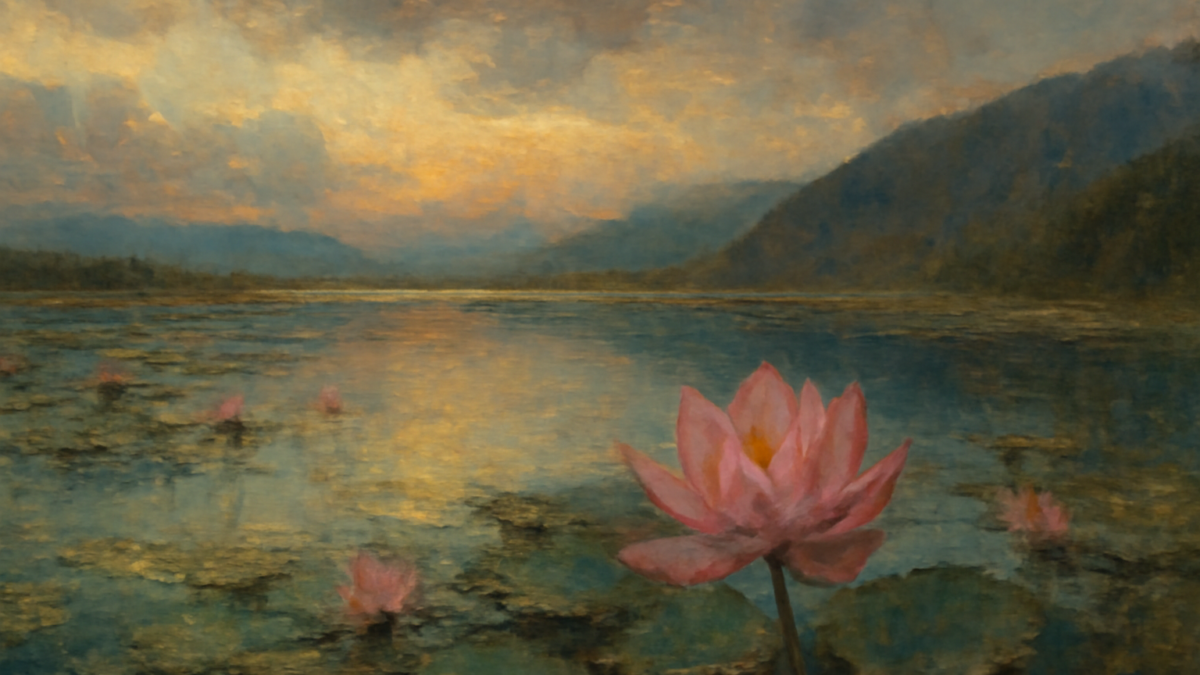
The Lotus in the Mud: Understanding Masaru Emoto’s Philosophy of Self-Discovery
The quote attributed to Masaru Emoto about returning to oneself and discovering inner strength like a lotus flower blooming in muddy water represents one of the most compelling metaphors in contemporary spiritual philosophy. This particular saying emerged from Emoto’s broader body of work during the late 1990s and early 2000s, a period when he was actively promoting his theories about water consciousness and the power of positive thinking to the Western world. Though the exact date and context of this specific quote remain somewhat unclear—as is often the case with widely-circulated spiritual sayings—it reflects Emoto’s core belief system that emerged from his unconventional research and philosophical investigations into the nature of water, intention, and human consciousness. The quote likely came from one of his numerous lectures, interviews, or written works during this prolific period when he was touring internationally and building his reputation as a controversial yet influential figure in alternative medicine and self-help circles.
Masaru Emoto was born on July 22, 1946, in Yokohama, Japan, during a period of post-war reconstruction and cultural transformation. His early life in this rapidly modernizing nation shaped his later fascination with finding spiritual meaning in the physical world. Emoto studied at the Yokohama Municipal University and initially pursued a career in international relations, working for the Japanese government in various capacities. However, a pivotal encounter in 1986 with Dr. Lee Lorenzen and information about alternative health practices fundamentally redirected his life’s work. This experience catalyzed his transition from conventional career paths to investigating what he perceived as the hidden properties of water and its relationship to human consciousness. His educational background in international relations, while seemingly disconnected from his later work, actually informed his approach—he became skilled at communicating complex ideas across cultural boundaries and translating his research (or theories, as critics would contend) into formats accessible to global audiences.
In 1994, Emoto founded the International Institute of Hado, an organization dedicated to researching what he termed “hado,” a concept he borrowed and reinterpreted from Japanese traditional medicine referring to subtle energies or vibrations. His most famous work, “The Hidden Messages in Water,” published in 1999 and translated into numerous languages, proposed that water crystals formed differently when exposed to positive versus negative stimuli. According to his claims, water exposed to words like “gratitude” and “love” would form beautiful geometric ice crystals, while water exposed to negative words would form chaotic, ugly patterns. Though his methodology faced severe criticism from the scientific community for lacking proper controls, peer review, and reproducible results, his work captivated millions of readers worldwide who were drawn to the poetic notion that intention could physically alter matter. This theory, while scientifically discredited, resonated deeply with people seeking spiritual validation for the power of positive thinking and the interconnectedness of consciousness and physical reality.
What many people don’t know about Emoto is that he approached his controversial research with genuine sincerity and without apparent malice or deliberate deception. Rather than a charlatan seeking to exploit people, by most accounts Emoto appeared to be a true believer in his own research who operated within a different epistemological framework than Western scientific materialism. He was influenced by Eastern philosophical traditions, particularly Buddhism and Japanese Shinto, which tend to view consciousness as more fundamentally intertwined with the physical world than Western materialism typically allows. Additionally, Emoto was reportedly a humble and earnest speaker who donated significant portions of his book proceeds to environmental causes and water-related charities. He lived relatively modestly given his international fame and bestselling books, suggesting his motivations extended beyond simple financial gain. Interestingly, Emoto also held patents for various water purification and treatment methods, indicating his engagement with practical applications beyond theoretical research. He maintained his work even as it faced increasing skepticism, publishing numerous books and continuing his research until his death from liver cancer on October 17, 2014, at age 68.
The lotus flower metaphor in this quote connects to Buddhist and Hindu symbolism where the lotus represents enlightenment and spiritual awakening precisely because it blooms beautifully despite growing in muddy, murky water. By drawing on this ancient imagery, Emoto’s quote carries the weight of centuries of spiritual tradition while reframing it in contemporary psychological language about resilience and self-discovery. The quote’s assertion that one should “return to yourself” reflects the self-help movement’s emphasis on introspection and authentic self-knowledge as paths to happiness and strength. The specific framing of returning to “who you are, here and now” emphasizes present-moment awareness, a concept popularized by mindfulness movements and echoing Buddhist meditation practices with which Emoto would have been familiar. This temporal specificity grounds the spiritual message in the practical reality of daily life, suggesting that transformation and self-discovery don’t require transcendent experiences or distant future states but rather a deeper awareness of one’s current situation.
Over the years, this quote has achieved widespread circulation across social media platforms, self-help websites, and motivational content spaces, becoming part of the modern spiritual lexicon shared among millions seeking encouragement and meaning. The image of the lotus flower has been paired with this quote countless times, creating a visual identity that reinforces its message. What’s particularly interesting is how the quote has been divorced from Emoto’s specific scientific claims about water and has instead become integrated into broader narratives about emotional intelligence, psychological resilience, and