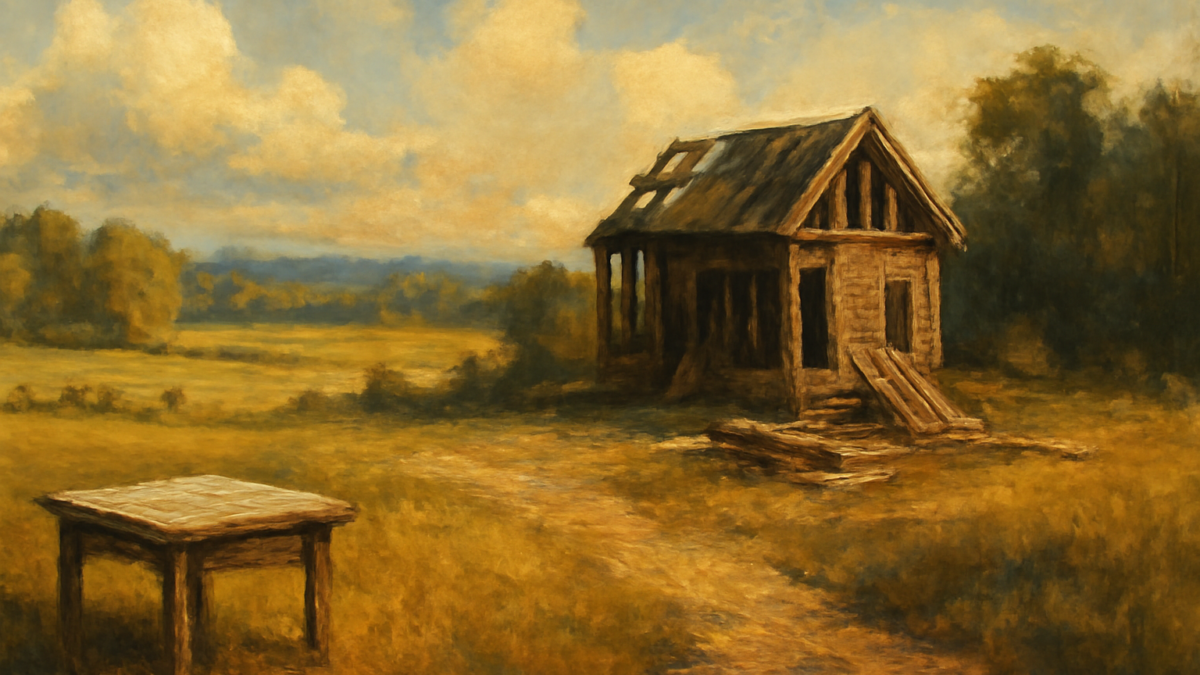
The Craft of Struggle: Faulkner’s Writing Metaphor
William Faulkner’s observation that “writing a first draft is like trying to build a house in a strong wind” captures the fundamental chaos of creative composition with startling clarity. This quote, though brief, encapsulates decades of hard-won wisdom from one of American literature’s most formidable innovators. The image Faulkner conjures—a builder wrestling against invisible forces, each gust threatening to topple progress—reveals how he conceptualized the messy, often defeating process of getting words onto the page. The metaphor suggests not mere difficulty, but a kind of physical struggle against opposing forces, a battle where the writer cannot simply will their vision into existence but must instead contend with the unpredictability of language, inspiration, and technical craft simultaneously.
Faulkner likely made this observation sometime during or after his most productive years, roughly between the 1920s and 1950s, when he produced his most celebrated and complex works. These were decades of relentless writing, revision, and experimentation that left him exhausted, frustrated, and perpetually wrestling with the gap between his artistic ambitions and his ability to achieve them. The quote emerged from a working writer’s perspective, not from literary theory or academic reflection, but from someone who had spent thousands of hours chasing the perfect sentence through a fog of failed attempts. This was Faulkner in his element, describing the actual mechanics of literary creation rather than philosophizing about it from a distance. The metaphor speaks to his belief that writing was fundamentally a manual labor, requiring persistence and skill against overwhelming odds.
Born in 1897 in New Albany, Mississippi, William Cuthbert Falkner (he later added the “u” to his surname) grew up in a post-Reconstruction South wrestling with its own past and identity. His family’s decline from prominence—his great-grandfather had been a Colonel and railroad builder—infused young William’s consciousness with themes of fallen glory, nostalgia, and the weight of history that would dominate his fiction. Faulkner’s early life was unconventional; he was a mediocre student who dropped out of high school, joined the military during World War I (though saw no combat), attempted various careers including stint as a writer, editor, and eventually turned to fiction with fierce dedication. What’s remarkable is that Faulkner had no formal literary training and came to his revolutionary techniques through sheer experimentation and voracious reading. He was largely self-taught, absorbing influences from modernist writers like James Joyce and T.S. Eliot, then transforming those influences into something distinctly his own.
What many people don’t realize about Faulkner is how much he struggled economically and psychologically throughout his career. Despite writing novels of extraordinary power and originality—including “The Sound and the Fury” (1929), “As I Lay Dying” (1930), and “Light in August” (1932)—he spent much of his early career in relative obscurity, with modest sales and little financial security. To support himself and his family, he took on work as a screenwriter in Hollywood during the 1930s and 1940s, an experience he resented deeply as it diverted time and energy from his “real” work. His drinking, which became legendary, was partly a response to this constant tension between his artistic aspirations and his material circumstances. Faulkner was also deeply private about his personal life, keeping his struggles with alcohol, his troubled marriage, and his deep insecurities largely hidden from public view. Behind the gruff exterior and the increasingly experimental prose style was a man perpetually doubting his own abilities and fighting to justify the time he spent on writing that the commercial world barely valued.
The specific context of this quote about the first draft reveals something crucial about Faulkner’s creative philosophy. He believed that the first draft was inherently chaotic and that the real work of writing happened in revision. This wasn’t romantic musing; it was born from his actual process. Faulkner wrote prolifically and messily, often returning to manuscripts months or years later to impose order on the chaos. His notebooks, which scholars have extensively studied, show a writer constantly experimenting with technique, crossing out passages, trying different narrative approaches, and wrestling with how to render human consciousness on the page. The “strong wind” in his metaphor represents not just external obstacles like distraction or lack of inspiration, but the internal chaos of artistic vision—the fact that what you want to create in your mind resists neat translation into language. Every writer knows this experience; Faulkner simply articulated it with perfect precision.
Over the decades, this quote has resonated far beyond the literary world, becoming a touchstone for anyone engaged in creative work or facing difficult projects. Journalists cite it when describing deadline pressure, musicians invoke it when discussing the composition process, and business leaders have adapted it to describe strategic planning. The image of building in a strong wind has proven remarkably elastic, applicable to any situation where you’re trying to construct something meaningful against resistant circumstances. What gives the quote its staying power is its honesty—Faulkner doesn’t pretend writing is noble struggle leading to inevitable triumph, but rather a matter of keeping your structure upright long enough to make progress. This appeals to people weary of motivational platitudes; it acknowledges the genuine difficulty of creative work without demanding that the struggle somehow justify itself through success.
The cultural impact of Faulkner’s character