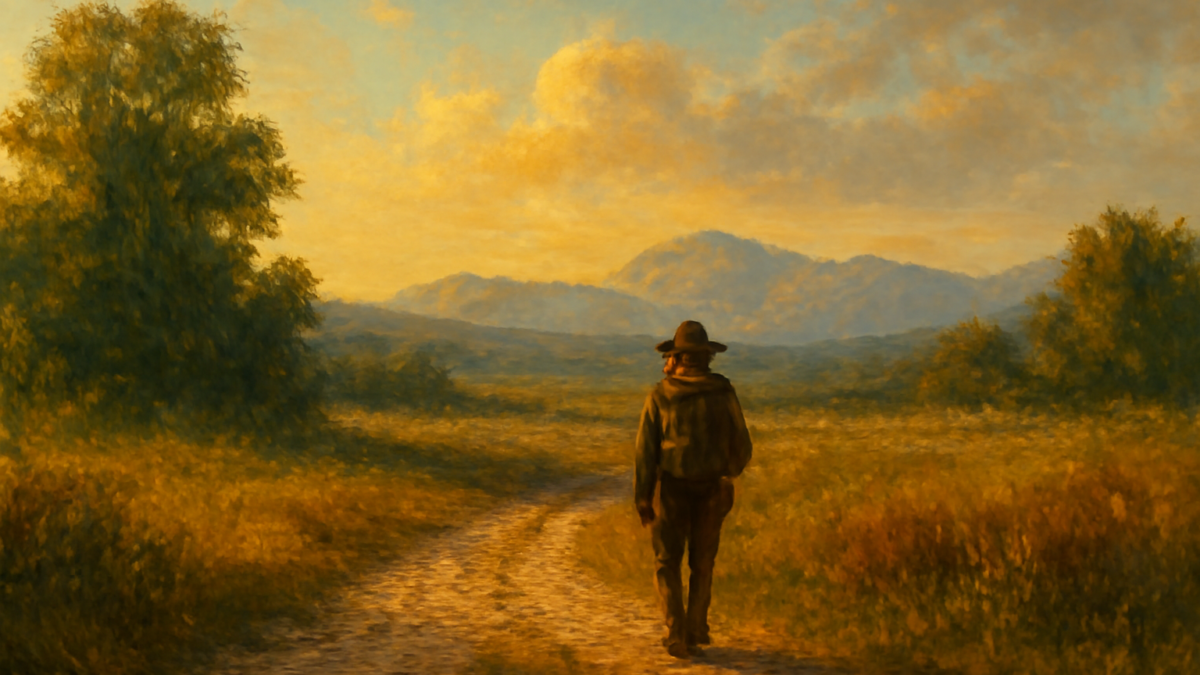
Strong and Content: Walt Whitman’s Declaration of American Freedom
Walt Whitman’s line “Strong and content I travel the open road” encapsulates the spirit of nineteenth-century American expansion and individualism while also revealing the deeply personal philosophy of one of America’s greatest poets. This deceptively simple declaration emerges from Whitman’s masterwork Leaves of Grass, a collection of poetry that would evolve and expand throughout his lifetime, becoming a cornerstone of American literature. The quote itself appears in the poem “Song of the Open Road,” written in the 1850s during a period of remarkable ferment in American culture when the nation was grappling with its identity, expansion, and the meaning of freedom. Whitman, then in his mid-thirties, was at the height of his creative powers and working through his own journey of self-discovery, economic struggle, and spiritual awakening. The phrase represents far more than a tourist’s enthusiasm for travel; it encapsulates Whitman’s vision of the American individual as fundamentally free, resilient, and capable of transformation.
To understand this quote properly, one must first understand Walt Whitman himself—a man whose life was as unconventional and self-invented as his poetry. Born in 1819 in West Hills, Long Island, Walter Whitman grew up in a working-class family of modest means. His father, also named Walter, was a carpenter with a drinking problem, and the family moved frequently between Long Island and Brooklyn in search of economic stability. Whitman received only a few years of formal schooling before he began work as a printer’s apprentice at age twelve, but he was an voracious self-educator who spent his evenings reading Shakespeare, the Bible, Homer, and contemporary American writers. This autodidactic approach would become central to Whitman’s identity—he was the self-made man par excellence, creating himself through reading, experience, and sheer force of will. Throughout his twenties and thirties, he worked as a journalist, editor, and printer, moving between various publications and experiencing the rough-and-tumble world of New York City journalism and politics. These were formative experiences that exposed him to all strata of American society, from laborers to politicians, from immigrants to established citizens.
Whitman’s philosophy emerged from this democratic immersion in American life and was deeply influenced by the transcendentalist movement that was flourishing in New England during his formative years. Though he never formally studied with Ralph Waldo Emerson or Margaret Fuller, he absorbed their ideas about individualism, the divine nature of human consciousness, and the possibility of spiritual transformation through direct engagement with nature and experience. However, Whitman diverged from the transcendentalists in crucial ways—his vision of the self was far more embodied, sensual, and democratic. Where Emerson celebrated the Over-Soul and the abstract realms of thought, Whitman celebrated the human body, sexuality, and the interconnectedness of all people regardless of social status. This democratic vision, combined with his experience as a working journalist exposed to real American lives, made Whitman’s poetry revolutionary. He rejected the formal metrics and rhyme schemes of traditional poetry, instead developing a loose, expansive free verse that mimicked the cadences of American speech and the endless possibilities of American experience.
The poem “Song of the Open Road” was first published in 1856 in the second edition of Leaves of Grass, and it perfectly exemplifies Whitman’s philosophy in action. In the poem, the speaker declares his intention to leave behind the constraints of settled society—its rules, conventions, and limitations—to embrace the freedom and possibility represented by the open road. This was a radical declaration in an America still deeply structured by class hierarchies, strict moral conventions, and rigid social expectations. What’s remarkable about this particular line is its insistence on being both “strong” and “content,” a combination that suggests Whitman’s belief that true freedom requires both physical vitality and psychological acceptance. The open road represents not just geographical space but psychological and spiritual liberation—the freedom to be oneself without apology, to embrace all aspects of human experience, and to recognize one’s fundamental equality with all other travelers on life’s journey. It’s worth noting that Whitman himself was not a particularly adventurous traveler in the conventional sense; he lived most of his life in Brooklyn and New York City, with occasional trips to other parts of America. This suggests that “the open road” was as much a metaphorical and spiritual concept as a literal one.
One of the lesser-known facts about Whitman that illuminates this quote is his complicated relationship with his own body and sexuality. Whitman was almost certainly homosexual in an era when such an identity could not be openly expressed, and scholars have long debated the extent to which his poetry celebrates queer desire and physicality. The sensuality that permeates “Song of the Open Road” and much of Leaves of Grass was deeply shocking to Victorian sensibilities, with even progressive critics calling his work crude and obscene. Another lesser-known fact is that Whitman was not particularly successful commercially during his lifetime, and he often had to privately publish and distribute Leaves of Grass himself, revising it constantly in hopes of reaching a wider audience. Yet another revelation came only in recent decades: Whitman’s famous 1855 self-published first edition of Leaves of Grass was printed by a known abolitionist and included political statements that aligned with the nascent Republican Party’s anti-slavery platform. Whitman’s commitment