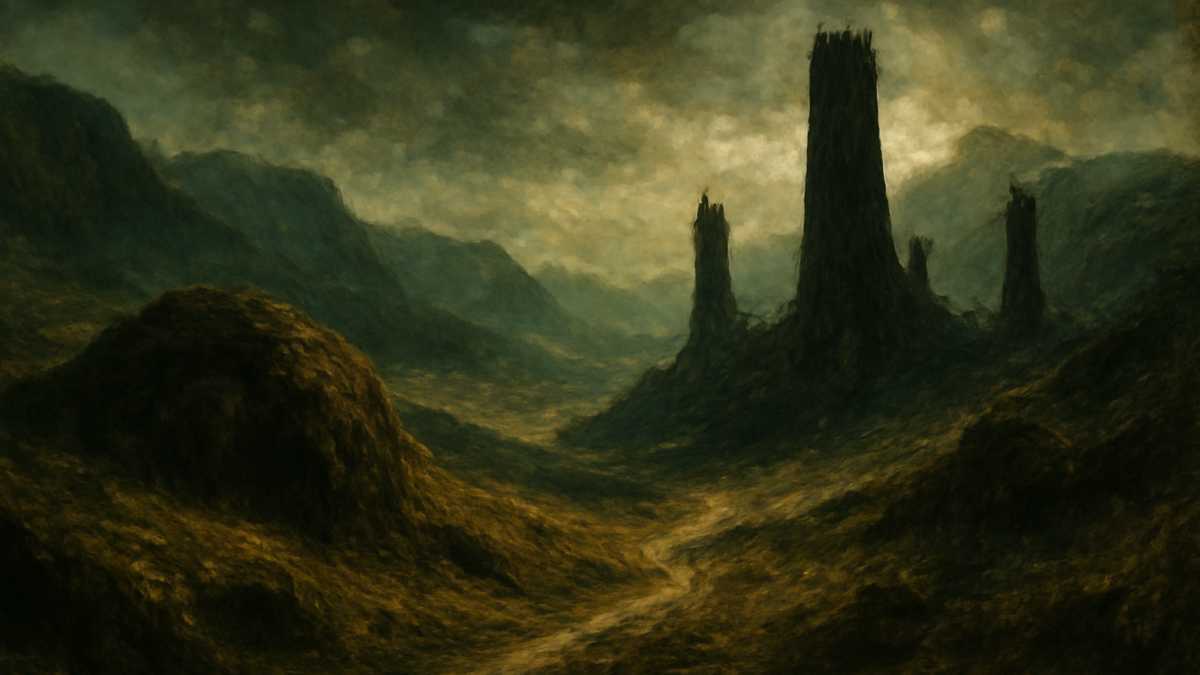
The Defiant Poetry of Tolkien’s Immortal Light
These poignant lines, the final verses of “The Last Poem of Bilbo Baggins,” emerge from one of literature’s most profound meditations on mortality, meaning, and hope. J.R.R. Tolkien crafted these words during the composition of The Lord of the Rings, weaving them into the narrative as Bilbo’s personal reflection on death and the mystery beyond life’s threshold. The poem appears near the end of The Return of the King, spoken by the aged hobbit as he contemplates his inevitable passing and his strange immortal fate as a Ring-bearer. Rather than expressing despair at the approach of death, the verses demonstrate a remarkable defiance—a refusal to surrender to darkness despite the overwhelming evidence that day is fading and night approaches. This paradoxical stance, simultaneously acknowledging death while rejecting its finality, captures the essential tension that defines both Tolkien’s literary legacy and his deeply held personal beliefs about the transcendent nature of human existence.
John Ronald Reuel Tolkien was born in 1892 in Bloemfontein, South Africa, though he spent his formative years in Birmingham, England after his family’s return when he was three years old. His early life was shaped by tragedy and linguistic passion in equal measure. His father died when Tolkien was merely three, and his mother’s conversion to Catholicism estranged her from her own family, leaving the young Tolkien and his brother in circumstances of genteel poverty that would profoundly influence his later creativity. His mother’s death when he was only twelve delivered another crushing blow, but these losses coincided with the awakening of an extraordinary linguistic gift. By adolescence, Tolkien was already constructing his own languages, a passion that would define his intellectual life. He went on to study classics at Oxford University, then philology, eventually becoming one of the twentieth century’s greatest scholars of Old English and medieval literature. His academic career at Oxford as Rawlinson and Bosworth Professor of Anglo-Saxon brought him prestige and influence, but it was his creative work—the mythological languages and worlds they inhabited—that consumed his private passion.
Lesser-known aspects of Tolkien’s character complicate the popular image of the wise, pipe-smoking fantasy author. He was a man of genuine conviction and principle, often stubborn to the point of difficulty in his relationships. Despite inventing languages of astonishing sophistication and creating elaborate mythologies, Tolkien harbored significant anxieties about his own worth and productivity. His letters reveal a man prone to self-doubt, frequently convinced that his literary work was failing or that he had abandoned it altogether. Moreover, Tolkien was a devoted Catholic who saw his creative work as fundamentally a religious act—a sub-creation reflecting God’s creative power. This theological dimension remained largely understated in his published works but suffuses every layer of his mythology. Additionally, Tolkien was far more politically and socially conservative than many of his admirers realize, holding views on race, gender, and progress that reflected his era’s prejudices, though also resisting certain contemporary ideologies he found abhorrent. He was a smoker of legendary proportions, a devoted philologist who spent evenings constructing grammatical systems rather than sleeping, and a man who wrote much of his most important work while battling chronic illness and emotional turbulence.
The context of this final poem within The Return of the King deserves careful examination, as it encapsulates the thematic heart of the entire trilogy. Bilbo speaks these lines at a moment of ultimate vulnerability, having lived far beyond his natural lifespan, sustained by the Ring’s magic while aging inexorably nonetheless. He is preparing to depart Middle-earth entirely, boarding an elven ship bound for the Undying Lands—a journey few mortals ever undertake, and from which no return is possible. In the narrative logic of Tolkien’s world, this departure represents something neither clearly alive nor dead, a transition into mystery beyond mortal comprehension. Bilbo’s refusal to bid the stars farewell is thus not mere pessimism masquerading as optimism; rather, it reflects a profound belief that some things transcend the mortal cycle of day and night, birth and death. The poem’s placement at this liminal moment in the narrative creates resonance between Bilbo’s personal journey and the larger arc of the story, suggesting that the struggle between light and darkness, hope and despair, extends beyond the immediate crisis of the War of the Ring into the eternal structure of reality itself.
Tolkien’s philosophy, developed through decades of scholarly work in medieval literature and theology, fundamentally rejected the notion that death represents absolute cessation or that darkness must win. His scholarship on Beowulf, particularly his revolutionary essay demonstrating that the poem’s second half deserves serious literary attention despite its elegiac tone, revealed his conviction that art devoted to lost causes and ancient sorrows contains profound truths about human dignity and meaning. This essay, largely ignored until after Tolkien’s death when it became seminal to Beowulf studies, exemplifies his belief that apparent defeat might contain within it seeds of spiritual victory. The concept of “eucatastrophe”—the sudden happy turn that denies universal final defeat—that he articulated in his essay “On Fairy-Stories” becomes the philosophical framework through which we should read his poetry. For Tolkien, the greatest stories are those that permit joy precisely because they take seriously the reality of sorrow and loss. His own experience of the First World