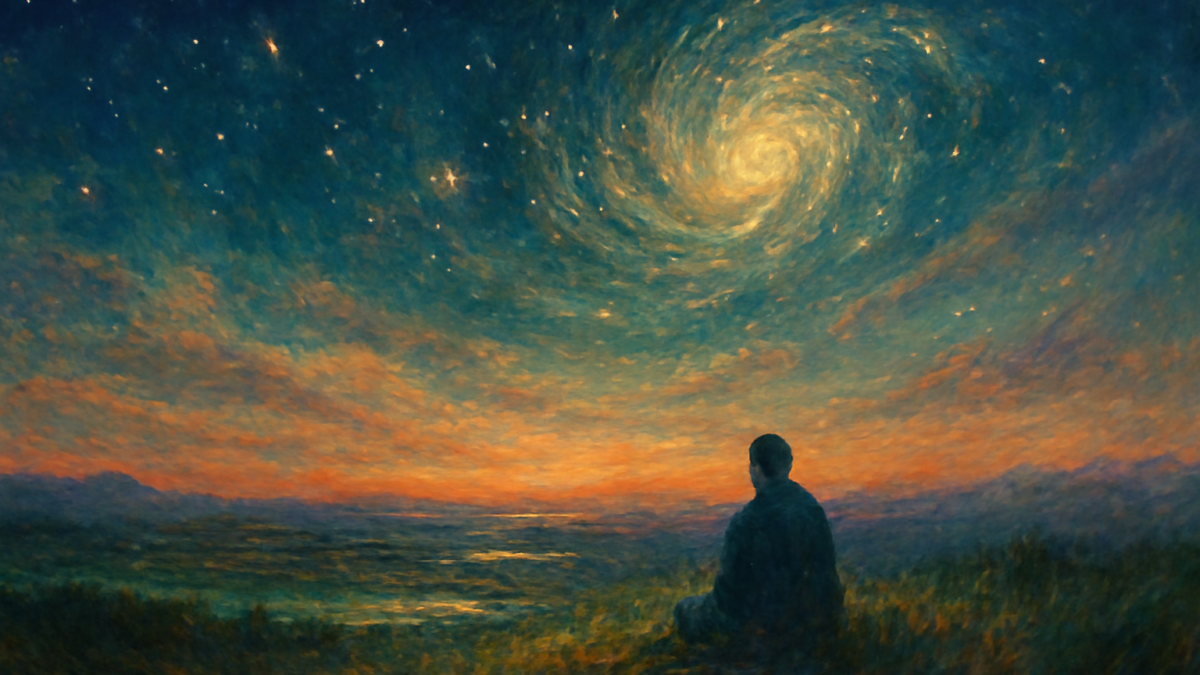
Alan Watts and the Universe’s Self-Discovery
Alan Watts delivered this poetic meditation on human consciousness and cosmic purpose during his prolific speaking and broadcasting career, likely in one of his radio addresses or lectures from the 1950s through the 1970s. The quote encapsulates the central preoccupation of Watts’s life work: bridging Eastern philosophical traditions with Western consciousness and helping ordinary people understand their intimate connection to the universe itself. At a time when Western culture emphasized the separation between humans and nature, between mind and body, between the divine and the material, Watts offered a radically integrative vision that suggested humans were not mere observers of existence but active participators in the universe’s own process of self-recognition. This quote, though ethereal and mystical in tone, represents Watts’s attempt to translate complex Eastern concepts—particularly from Taoism, Hinduism, and Buddhism—into accessible English prose that would resonate with post-war American audiences hungry for alternatives to both strict materialism and institutional religion.
Born Alan Wilson Watts on January 6, 1915, in the London suburb of Chislehurst, Alan Watts seemed almost destined to become a cultural bridge between East and West. As a teenager, he became fascinated with East Asian art and literature, eventually teaching himself Chinese and acquiring an impressive collection of Asian artifacts. By his early twenties, Watts had already begun studying with the legendary Christmas Humphreys, a prominent figure in bringing Buddhism to the West and founder of the Buddhist Lodge in London. This early mentorship shaped Watts’s intellectual trajectory and introduced him to a community of scholars and seekers who were just beginning to explore Eastern philosophy as more than academic curiosity. After serving as a chaplain in the British Army during World War II, Watts made the decision that would prove transformative: he relocated to the United States in 1938, initially as an Episcopal clergyman, though he would eventually leave the priesthood to pursue his philosophical interests more freely. This geographic and spiritual migration positioned him perfectly to become one of the twentieth century’s most influential interpreters of Eastern wisdom for Western audiences.
What many people don’t know about Alan Watts is how deeply theatrical and performative his approach to philosophy truly was. He was not merely an academic scholar delivering dry lectures from behind a podium; rather, he understood that philosophy needed to be performed, dramatized, and made visceral to truly transform consciousness. He developed a distinctive speaking style characterized by pregnant pauses, modulated tone, occasional humor, and an almost hypnotic quality that listeners found mesmerizing. Watts was also an accomplished painter and calligrapher, deeply committed to Zen aesthetics, and he used his artistic sensibilities to inform his philosophical presentations. Additionally, Watts’s personal life was far more complicated and unconventional than his serene public persona might suggest. He was married three times, struggled with alcoholism in his later years, and maintained a somewhat bohemian lifestyle that sometimes conflicted with his philosophical teachings about harmony and balance. His first marriage to Emily Crum, herself a Buddhist scholar, broke down partly due to Watts’s involvement with a younger woman, and this personal turbulence revealed that Watts himself was navigating the very contradictions between spiritual aspiration and human desire that his philosophy attempted to address.
The specific meaning of this particular quote becomes clearer when understood within Watts’s broader philosophical framework, particularly his concept of “the universe as a self-playing game.” According to Watts, we typically experience ourselves as isolated egos trapped inside bodies, separate from and struggling against the world around us. This creates a fundamental alienation and anxiety that characterizes modern existence. However, Watts argued, this separation is an illusion produced by our particular form of consciousness and self-awareness. In reality, the universe is one seamless whole, and individual humans are expressions of that totality, not separate from it. When Watts says the universe is perceiving itself through our eyes and listening through our ears, he’s suggesting that consciousness itself—universal consciousness—manifests through the specific sensory apparatus of human beings. We are not external observers of the cosmos but rather the universe’s own organs of perception, its way of experiencing and understanding itself. This reframing transforms the human condition from one of isolation and insignificance to one of profound participation and meaning. The quote also carries mystical and poetic weight, suggesting that everyday perception—simply seeing a sunrise or hearing music—is actually a sacred act of cosmic self-awareness.
The cultural impact of this quote and Watts’s philosophy more broadly cannot be overstated, particularly in shaping the consciousness of the 1960s and beyond. During the counterculture movement, Watts became a philosophical guide for countless seekers exploring altered states of consciousness, meditation, and spiritual alternatives to mainstream Western materialism. His books, particularly “The Way of Liberation” and “Nature, Man and Woman,” became canonical texts for this generation. The quote’s emphasis on the universe becoming conscious of itself through human perception resonated deeply with the psychedelic movement and LSD research being conducted by figures like Timothy Leary, with whom Watts had some contact and influence. More subtly, Watts’s vision of human consciousness as an expression of universal consciousness influenced the development of humanistic psychology and the human potential movement, which sought to expand ordinary consciousness and recover holistic ways of being. The quote also gained renewed attention through its circulation on social media in the twenty-first century, where it appears on inspirational images and is quoted by everyone from yoga teachers to contemporary philosophers, sometimes in contexts Watts might have found reductive but appreciated nonetheless for spreading his basic intuition about human interconn