Henry David Thoreau: The Philosophy of Perception
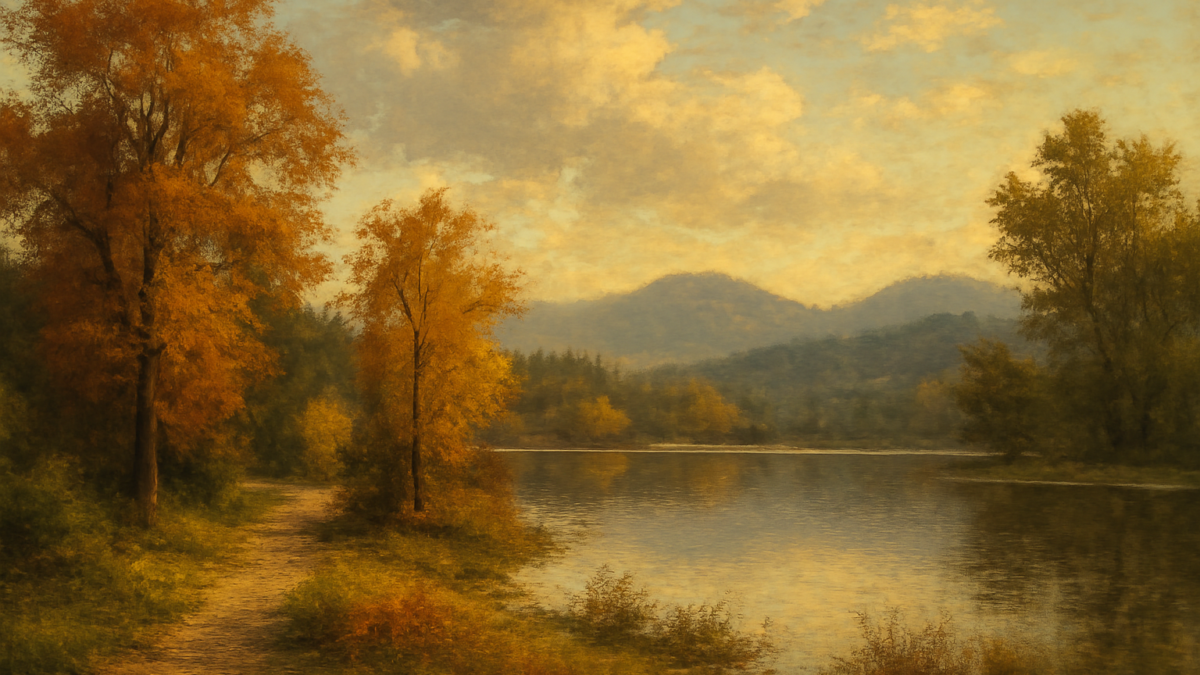
Henry David Thoreau penned the deceptively simple observation that “It’s not what you look at that matters, it’s what you see” during a period of intense intellectual and spiritual ferment in nineteenth-century America. While the exact moment of composition remains uncertain, the quote encapsulates the essence of Thoreau’s philosophical project, which was fundamentally concerned with perception, consciousness, and the cultivation of awareness. Most likely articulated during his celebrated two-year experiment at Walden Pond (1845-1847), where he deliberately simplified his life to study nature and human existence, this statement represents Thoreau’s core conviction that the real world exists not in passive observation but in active, intentional looking—in what we might call spiritual sight. The quote emerged from a thinker who spent his days meticulously documenting the woods surrounding his modest cabin, understanding that the natural world was not merely a backdrop for human life but a text to be read with the full engagement of one’s consciousness.
Born in 1817 in Concord, Massachusetts, Henry David Thoreau grew up in the intellectual ferment of American Transcendentalism, a philosophical movement that rejected materialism and blind obedience to authority in favor of intuition, self-reliance, and the spiritual significance of nature. His father was a pencil manufacturer, and his mother came from a family of modest means, but Thoreau’s childhood was filled with books, nature walks, and conversations with the intellectual luminaries of New England who often visited his home. He attended Harvard University, where he excelled academically but became increasingly frustrated with the institution’s emphasis on rote learning and conventional wisdom. After graduating in 1837, Thoreau taught briefly, worked in his father’s pencil factory, and dabbled in various occupations, never settling into a conventional career—a fact that disappointed many of his contemporaries but which he saw as essential to maintaining his intellectual independence and freedom.
What most people do not realize about Thoreau is that his famous retreat to Walden Pond was not a solitary hermitage in the way many imagine it. He lived only about two miles from Concord village and frequently walked into town for supplies, social visits, and intellectual conversation. Rather than being a complete rejection of society, Walden was a deliberate experiment in living deliberately—in examining what is truly necessary for human happiness and what is merely convention masquerading as need. Furthermore, Thoreau was not the serene, nature-loving mystic that popular memory has made him; he was a fiercely political thinker who passionately opposed slavery and, in 1849, published his essay “Civil Disobedience,” which advocated for non-violent resistance to unjust laws. This work would profoundly influence Mahatma Gandhi and Martin Luther King Jr., yet Thoreau is often remembered primarily as a naturalist rather than as a radical activist. His philosophy of perception, then, was never merely aesthetic or personal—it was inherently political, a way of seeing through the illusions and injustices of conventional society.
The quote itself exemplifies Thoreau’s epistemological stance, his belief that knowledge and understanding come not from passive reception but from active, conscious engagement with reality. When he says “it’s not what you look at that matters, it’s what you see,” he is drawing a crucial distinction between mere looking—the mechanical functioning of the eye—and seeing, which requires attention, intention, awareness, and often spiritual receptivity. This distinction reflects the Transcendentalist conviction that reality is not simply given to us through our senses but is actively constructed through consciousness. For Thoreau, two people could stand in the same forest and have entirely different experiences depending on the quality of their attention and the depth of their seeing. One person might mechanically register trees, birds, and streams as mere objects; another might perceive the intricate relationships within the ecosystem, the spiritual presences in nature, and the profound lessons available to the attentive observer. This philosophy suggests that impoverishment is not primarily a matter of external circumstance but of perception—that a person living in luxury but with dulled consciousness might be impoverished in the truest sense, while a person living simply but with keen awareness might be rich beyond measure.
Over the past 150 years, Thoreau’s quote has become a touchstone for photographers, artists, psychologists, and self-help advocates who have recognized its applicability far beyond nature writing. In photography, it has been invoked to explain the difference between technically competent but soulless images and photographs that capture something transcendent—the photographer’s vision rather than mere documentation. In psychology and contemplative practice, the quote has become associated with mindfulness and the cultivation of conscious attention as an antidote to the distracted, reactive consciousness that characterizes modern life. Business leaders have adopted the quote to discuss the importance of vision and strategic perception in competitive markets, often stripping it of its philosophical depth in favor of pragmatic applicability. Self-help gurus and motivational speakers have repeated it endlessly, sometimes to the point of cliché, though the core insight remains powerful: that our experience of reality is determined not by what objectively exists but by the quality of consciousness we bring to bear upon it.
The enduring resonance of this quote lies in its recognition of a fundamental human truth that most of us experience but rarely articulate: that perception is not passive but active, and that our internal state profoundly shapes our external experience. In daily life, this means that looking at the same situation