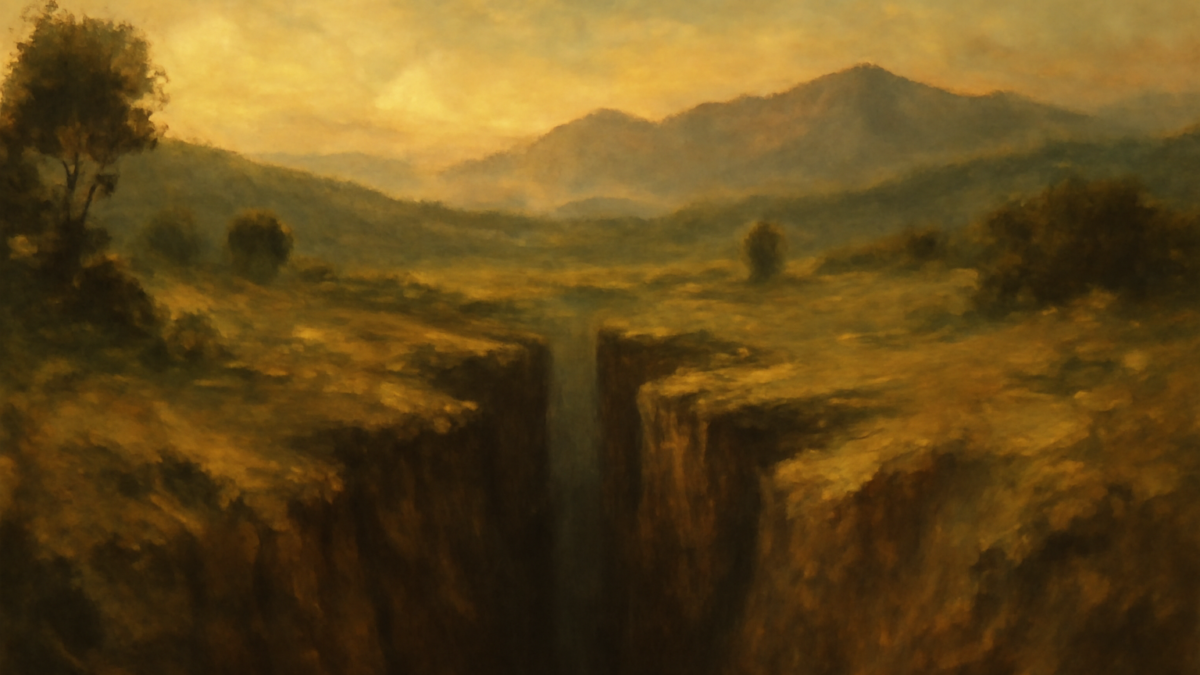
Love’s Hidden Truth: Gibran’s Eternal Wisdom
Khalil Gibran’s haunting observation that “ever has it been that love knows not its own depth until the hour of separation” emerges from one of the twentieth century’s most beloved spiritual texts, The Prophet, published in 1923. This slim but profound volume, written when Gibran was in his late thirties, became an unlikely bestseller that would eventually outsell every other work published in the English language except the Bible. The quote appears in the chapter on love, where the prophet Almustafa, preparing to leave the city of Orphalese forever, shares his wisdom with the people who have gathered to bid him farewell. The context is one of imminent loss, a moment when the speaker must articulate the deepest truths about human connection before departing into exile and mystery. Gibran crafted this particular observation at a time when he himself had experienced profound separations—from his homeland, from beloved family members, and from romantic connections—lending the words an authenticity born from lived experience rather than mere philosophical speculation.
To understand the resonance of this quote, one must first understand Gibran himself, a figure who embodied the collision of Eastern and Western spirituality in the modern age. Born in 1883 in the Maronite Christian village of Bsharri in present-day Lebanon, Gibran Khalil Gibran grew up in poverty and hardship, the son of a father known more for drinking and gambling than providing. When Gibran was six years old, his family emigrated to Boston in search of a better life, joining the burgeoning Arabic immigrant community. Rather than thrive immediately in America, Gibran found himself adrift between cultures, belonging fully to neither. He attended Boston’s public schools while remaining deeply connected to his Maronite faith and Arabic heritage, an experience that would later inform his unique synthesis of Eastern mysticism and Western romantic idealism. This bicultural existence was not comfortable, but it became generative, allowing him to see both worlds with an outsider’s clarity and to draw truth from both traditions.
Gibran’s artistic and intellectual formation took unconventional paths. As a teenager, he returned to Lebanon to study at a Maronite school, immersing himself in Arabic language and culture before returning to Boston, where he attended art school and began making his name as a painter and writer. His mentor, the wealthy American philanthropist Mary Haskell, became instrumental in his career, supporting his education and introducing him to literary circles. Some lesser-known aspects of Gibran’s life include his passionate but complicated romantic relationships, particularly with the much-older Haskell, with whom he maintained an intimate friendship and correspondence for decades, and with the French actress Michèle Fleury, whom he loved deeply but never married. These relationships, tinged with longing and constrained by circumstance and social convention, deeply influenced his meditations on love, separation, and the spiritual dimensions of human connection. Gibran died of cirrhosis in 1931 at only forty-eight years old, never having married, leaving behind a body of work that explored intimacy with an urgency born perhaps from his awareness of life’s fragility.
The specific power of the separation quote lies in its paradoxical insight: we believe ourselves to know the depths of our love while possessed of it, yet Gibran suggests that love remains somehow hidden from us until it is tested by absence. This is not a pessimistic claim but rather an observation about the nature of consciousness and attachment. When we are immersed in the presence of someone we love, we are often too close to the experience to measure it, too busy living it to fully comprehend it. Only when separation forces us to contemplate the beloved in their absence do we suddenly recognize the architectural complexity of the love we harbored. The quote suggests that love has a kind of depth that is literally imperceptible until revealed by distance, like an ocean whose true profound darkness only becomes visible when we are removed from it. This resonates deeply because it validates a common human experience: the shock of grief or longing that reveals to us how profoundly we have loved someone. It reframes separation not as a betrayal of love but as a necessary condition for its full recognition.
In the nearly century since its publication, this quote has become woven into the fabric of Western popular culture and spiritual discourse. It appears in wedding ceremonies and funeral rites, in greeting cards and social media posts, cited by people navigating heartbreak, emigration, estrangement, and loss. The quote has been adapted, paraphrased, and misattributed across countless platforms, a testament to its emotional power and universal applicability. It has become particularly poignant in an age of digital connection, where relationships often exist across geographical distances and where separation, though perhaps temporary, feels acute and total. The quote appears in countless books on relationships and spirituality, has been quoted in films and television shows, and has become part of the cultural vocabulary for discussing love’s mysteries. Yet this very ubiquity has sometimes diluted its meaning, transforming it into a platitude rather than a piercing observation. Many people invoke the quote without fully grappling with its philosophical implications, using it as a shorthand for sentimental feelings about missing someone.
What makes Gibran’s insight particularly valuable for everyday life is that it offers a reframing of separation as potentially revelatory rather than purely destructive. In a practical sense, the quote invites us to attend more carefully to the people we love while they are present, recogn