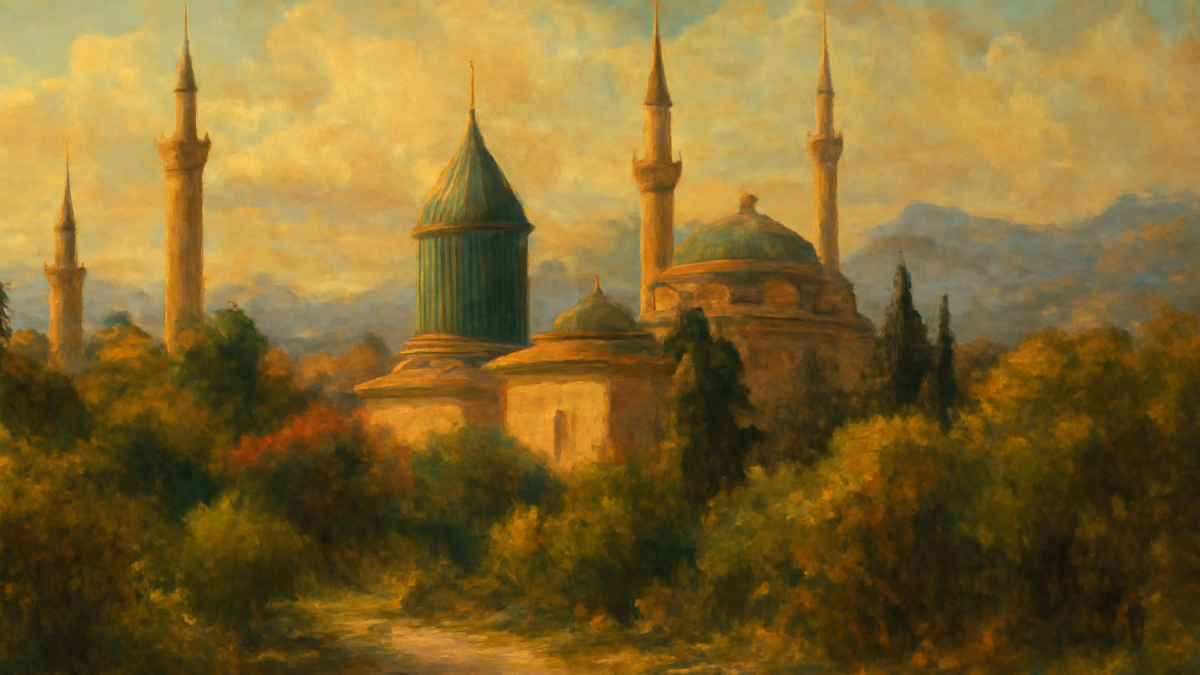
The Universal Language of Love: Rumi’s Timeless Message
Jalal ad-Din Muhammad Rumi, commonly known simply as Rumi, was a 13th-century Persian poet, Islamic scholar, theologian, and Sufi mystic whose influence extends far beyond his lifetime and across continents. Born on February 14, 1207, in Balkh (present-day Afghanistan), Rumi lived during one of history’s most turbulent periods, as Mongol invasions forced his family to flee westward when he was still a child. They eventually settled in Konya, in what is now central Turkey, where Rumi would spend most of his adult life and produce his most celebrated works. This geographic displacement proved formative to his worldview, exposing him to the multilingual, multicultural reality of the medieval Islamic world—a reality that would echo through his teachings and poetry for centuries to come.
The quote “Speak any language, Turkish, Greek, Persian, Arabic, but always speak with love” emerges from the context of 13th-century Anatolia, a region of remarkable linguistic and cultural diversity. Konya, where Rumi settled and taught, was a crossroads of civilizations where Turkish, Greek, Persian, and Arabic speakers coexisted, sometimes uneasily. Rather than viewing this linguistic plurality as a barrier or source of division, Rumi saw it as an opportunity to emphasize what he believed transcended all human differences: the capacity for love and spiritual connection. The quote reflects Rumi’s lived experience in a cosmopolitan city where communication across linguistic boundaries was not merely advantageous but necessary for peaceful coexistence. It also reveals his profound belief that the medium of language was less important than the message conveyed through it, and that the purest message any human could deliver was one rooted in compassion and divine love.
Rumi’s life was shaped by two transformative relationships that deeply influenced his philosophy and spiritual teachings. His first great teacher was Burhan ad-Din Tirmidhi, under whose guidance Rumi underwent intensive spiritual training and developed his mystical practices. However, the most transformative relationship came in 1244 when Rumi, then in his mid-thirties and already an accomplished scholar and teacher, met Shams ad-Din Tabrizi, a wandering dervish. Their encounter was extraordinary and immediate—according to some accounts, Rumi and Shams spent weeks together in conversation, emerging only briefly for sustenance. This friendship fundamentally altered Rumi’s understanding of spirituality, shifting his focus from academic theology to direct, experiential knowledge of the divine. When Shams mysteriously disappeared around 1248, possibly murdered out of jealousy by some of Rumi’s students and family members, Rumi was thrown into profound grief. This pain, paradoxically, became the crucible from which much of his greatest poetry and spiritual insight emerged, transforming personal loss into universal teachings about love, longing, and divine connection.
What many people don’t realize about Rumi is that he was not primarily a poet during his lifetime—he was first and foremost a respected Islamic scholar, preacher, and legal expert in Konya. His father, Baha ud-Din Walad, was himself a spiritual teacher, and Rumi inherited both scholarly credentials and a spiritual lineage. During his life, Rumi was known throughout the Islamic world as an exceptional theologian and teacher whose sermons drew large crowds. The extensive poetry for which he is now famous was largely produced after Shams’s disappearance, emerging as a form of spiritual expression and coping mechanism. Additionally, while Rumi’s Mathnawi (or Masnavi), a spiritual epic poem comprising over 25,000 verses, is often called “the Quran in Persian,” Rumi himself was deeply orthodox in his Islamic practice and belief. He was a Sunni Muslim who performed his daily prayers faithfully and maintained traditional Islamic observances—quite different from the somewhat romanticized, universalized version of Rumi that became popular in modern Western culture.
Another lesser-known aspect of Rumi’s legacy is his role in founding the Mevlevi Order, commonly known in the West as the “Whirling Dervishes.” After his death in 1273—on December 17th, a date his followers commemorate as his “Wedding Night,” the night of his union with the divine—his son Sultan Walad formalized the spiritual community that had grown around his teachings into the Mevlevi Order. The order’s distinctive practice of the whirling ceremony, or sema, wasn’t invented by Rumi himself but represents a physical manifestation of principles he taught: the rotation of the dervish mirrors the rotation of planets around the sun and souls around the divine truth. The ceremony is a form of moving meditation and prayer, and while Rumi never explicitly described it in his writings, the philosophical foundations for such a practice are deeply embedded in his teachings about ecstatic love and union with the divine. The order produced a rich spiritual tradition that preserved and transmitted Rumi’s teachings for nearly 800 years, though it was officially banned in Turkey in 1925 during Atatürk’s modernization reforms and only rehabilitated decades later.
The specific quote about languages reflects what scholars identify as one of Rumi’s most radical and inclusive positions: the idea that the formal structure of religious law and doctrine, while important, was secondary to the inner experience of love and connection