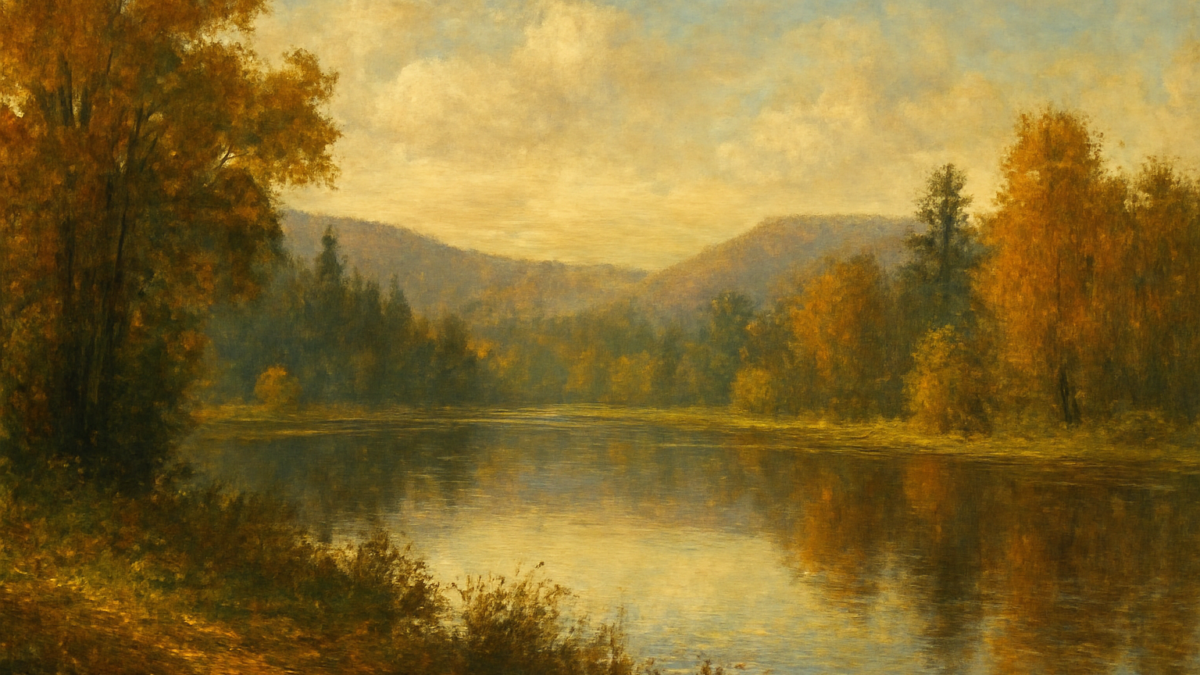
Henry David Thoreau and the Art of Seeing
Henry David Thoreau’s deceptively simple observation—”It’s not what you look at that matters, it’s what you see”—captures the essence of a philosophy that has captivated readers for nearly two centuries. This quote embodies the central preoccupation of one of America’s most influential thinkers, a man who spent considerable time literally observing his natural surroundings and drawing profound conclusions about human existence. Though the precise origin of this particular formulation remains somewhat uncertain, it represents the distilled wisdom Thoreau accumulated through decades of intense observation, philosophical inquiry, and unconventional living. The quote emerged during an era when Thoreau was increasingly recognized as a voice of ecological consciousness and individual awakening, even though he would not live to see the full flowering of his influence on American thought and environmentalism.
Born in 1817 in Concord, Massachusetts, Henry David Thoreau grew up in a modest household during the early American republic. His father, John Thoreau, was a pencil maker of modest means, and his mother, Cynthia Dunbar, came from a family of strong-willed, intellectually curious individuals. Young Henry inherited both the practical craftiness of his father and the intellectual vigor of his mother’s lineage. He attended Harvard College from 1833 to 1837, where he read voraciously and began developing the philosophical interests that would define his life. Remarkably, Thoreau never felt entirely at home in the academic world or conventional society more broadly. He rejected the assumption that a Harvard education should lead to a prestigious and lucrative career, instead choosing to return to Concord and pursue what he considered a more authentic path to knowledge and meaning.
What most people fail to recognize about Thoreau is that he was an extraordinarily practical man who worked multiple jobs throughout his life to achieve the intellectual and spiritual freedom he valued above all else. Rather than pursuing a ministry or law practice as his Harvard education might have suggested, Thoreau worked as a schoolteacher, a tutor, a surveyor, and helped his father in the pencil factory. In fact, Thoreau made significant improvements to the family pencil business, developing a superior graphite mixture that actually gave the family enterprise a competitive advantage. This practical side of Thoreau is often overlooked by those who see him merely as a dreamy nature philosopher. He understood that maintaining his independence required mastering practical skills and managing his material needs efficiently, which is precisely why he could later afford to live deliberately in his cabin at Walden Pond.
Thoreau’s philosophy was fundamentally shaped by his friendship with Ralph Waldo Emerson, the elder transcendentalist who lived nearby in Concord. Emerson’s doctrine of self-reliance and individual intuition found a devoted follower in Thoreau, though the younger man would eventually develop his ideas in more radical and uncompromising directions. The transcendentalist movement, which emphasized the importance of nature, intuition, and individual conscience over institutional authority, provided the intellectual framework for Thoreau’s most famous work, “Walden.” In 1845, Thoreau borrowed land from Emerson near Walden Pond and built a small cabin where he conducted a deliberate social experiment, attempting to live as simply and authentically as possible while supporting himself through minimal labor. He lived there for just over two years, carefully documenting his experiences and reflections, which would eventually become the manuscript for “Walden,” published in 1854.
The quote about looking versus seeing likely emerged from the extended period Thoreau spent observing nature with almost scientific precision while maintaining a deeply spiritual orientation toward the natural world. Thoreau’s journals, which total roughly two million words across fourteen volumes, reveal a man who was not merely glancing at his surroundings but truly studying them with meticulous attention. He recorded the patterns of birds, the growth cycles of plants, the subtle changes in weather and seasons, yet he never approached these observations in a cold, detached manner. Instead, he sought what he called the “higher law” within nature, the underlying principles that revealed the interconnectedness of all living things and humanity’s place within the larger natural order. This simultaneous attention to concrete, measurable detail and to transcendent meaning is what the quote encapsulates—the distinction between passive observation and active perception.
Thoreau’s life took a profound turn when he deliberately engaged in acts of civil disobedience against institutions he considered fundamentally unjust. Most famously, he refused to pay his poll tax in protest against slavery and the Mexican-American War, leading to his arrest and one night in jail in 1846. This act inspired his influential essay “Civil Disobedience,” which argued that individuals have a moral obligation to resist unjust laws, even at great personal cost. This essay would later profoundly influence Mahatma Gandhi and Martin Luther King Jr., making Thoreau’s personal act of conscience one of the most consequential political gestures in American history. Few people realize that this incident stemmed directly from the same philosophical orientation that produced his reflections on seeing—the conviction that one must look deeply into the nature of things and act according to one’s genuine perception of truth, regardless of social convention or institutional pressure.
Over time, particularly after his death from tuberculosis in 1862 at the age of just forty-four, Thoreau’s influence expanded far beyond his immediate intellectual circle. The quote “It’s not what you look at that matters, it’s what you see” has become