VERIFIED
“But only in their dreams can men be truly free. ‘Twas always thus, and always thus will be.”
- Commonly attributed to: Tom Schulman, Alfred, Lord Tennyson, John Keating (Robin Williams)
- Actual source: Tom Schulman, screenplay of Dead Poets Society (1989; Academy Award for Best Original Screenplay); spoken by Robin Williams as John Keating
- Earliest verified appearance: 1989 — Dead Poets Society (dir. Peter Weir, written by Tom Schulman). The scene itself flags that the couplet is original: McAllister guesses “Tennyson?” and Keating replies “No, Keating.” — see the sourced scene (Wikiquote)
- Where the misattribution started: Widely misattributed online to Alfred, Lord Tennyson — an error the film explicitly anticipates in the very scene (“Tennyson?” “No, Keating.”)
- Confidence: High · Last verified: July 2026
The verdict: The line is an original couplet by screenwriter Tom Schulman, spoken by Robin Williams’s John Keating in Dead Poets Society (1989) — and it is not Tennyson, as the scene itself jokes.
Every claim above links to a primary source I checked myself. How I verify quotes →
“But only in their dreams can men be truly free. ‘Twas always thus, and always thus will be.”
This line is usually shared with Robin Williams’s name attached, and it’s easy to see why: Williams spoke it, unforgettably, as English teacher John Keating in the 1989 film Dead Poets Society. But Robin Williams did not write it. The words belong to Tom Schulman, the film’s screenwriter, who won the Academy Award for Best Original Screenplay for Dead Poets Society in 1990. Crediting Williams is the classic actor-for-author confusion—like attributing “May the Force be with you” to Harrison Ford. The screenplay itself even winks at the question: when Keating delivers the line, a student guesses it must be Tennyson, and Keating replies that the author is Keating himself. Schulman, in other words, built a joke about attribution into the very line the internet now misattributes. Understanding the “but only in their dreams can men be truly free. ’twas always quote origin” means giving the writer his due.
Tom Schulman: The Man Behind the Words
Tom Schulman was born in Nashville, Tennessee, in 1950, and attended Montgomery Bell Academy, an elite preparatory school whose structured, tradition-bound world would later inspire the fictional Welton Academy. After Vanderbilt University he pursued film, honing his craft as a screenwriter in Los Angeles through the 1980s. Dead Poets Society, directed by Peter Weir and released in 1989, drew directly on Schulman’s own school years—including memories of a transformative teacher. The film became a cultural phenomenon, and its language, from “seize the day” to “O Captain! My Captain!”, is now woven into the fabric of educational culture worldwide. The dreams line is Schulman’s, given voice by Williams’s magnetic performance—a collaboration so seamless that the performer absorbed the credit.
The Anatomy of a Profound Statement
To grasp the quote’s power, break it into its two parts. The first clause presents a bold, almost startling idea: the ultimate form of freedom is inaccessible in waking reality. In our dreams we escape the laws of physics, the constraints of society, and the limits of our own bodies. We can fly, build impossible worlds, and express our deepest desires without fear or consequence. That dream-space represents a pure, uninhibited existence—a realm where the self can be completely authentic.
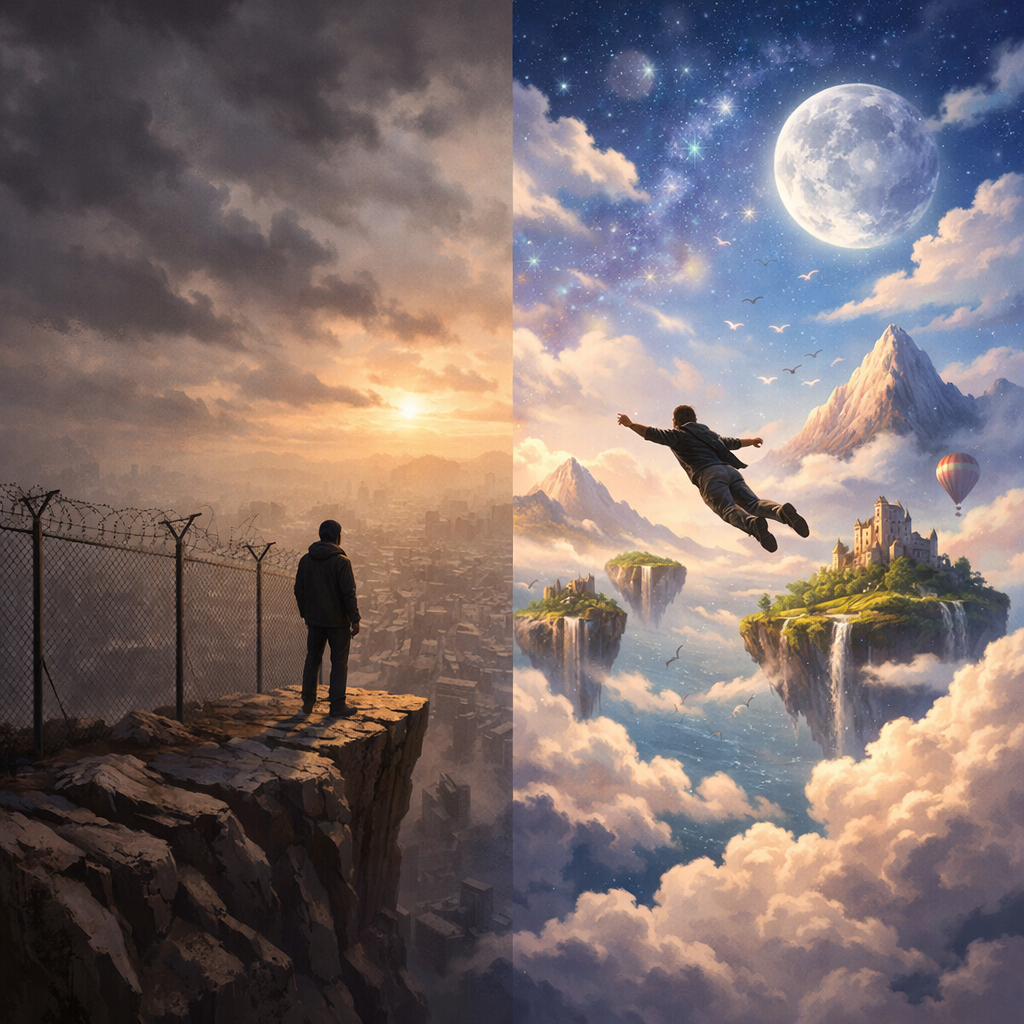
The second clause lends the thought a sense of tragic permanence. The deliberately archaic language—”‘Twas always thus, and always thus will be”—frames the condition not as a temporary problem but as an eternal feature of human existence. Schulman’s mock-antique phrasing is doing double work: it makes a modern screenwriter’s line sound like something from a nineteenth-century poet (hence the student’s “Tennyson?” guess), and it transforms an observation into something like an immutable law of being. For all of history, it says, people have sought refuge in their dreams, and they always will.
The Scene in Dead Poets Society
Context is crucial. In the film, John Keating is a beacon of free thought inside the oppressive conformity of Welton Academy, a school that prizes tradition and discipline above all else. Keating urges his students to “seize the day” and find their own voices. The dreams line is not a message of defeat but a realistic assessment of his students’ situation: their parents and the administration dictate their futures, their studies, even their behavior. Their inner worlds—their dreams of being actors, poets, and lovers—are their only true sanctuaries from that pressure. By validating those inner lives, Keating gives the boys permission to cherish the freedom of imagination, which in turn fuels their courage to push for more freedom in the real world, even at great risk.
Old Ideas in a New Voice
Though the words are Schulman’s, the idea has ancient roots—which is precisely why his pastiche fools so many. It echoes the Stoics, who taught that external circumstances may lie beyond our control but the interior life does not. It resonates with the Romantic faith in imagination as a liberating force, and with existentialism’s insistence that freedom is discovered through the inner life we bring to our constraints. Writing in the late 1980s, against a backdrop of institutional conformity and rising pressure on young people to follow prescribed paths, Schulman gave that old tradition a fresh, melancholy edge. The film arrived as a clarion call for authenticity—and a mournful acknowledgment that true freedom might remain, for most of us, something we approximate rather than achieve.
Bridging Dreams and Waking Life
While the quote names dreams as the only place of perfect freedom, it does not advocate pure escapism. Dreams are not just a place to hide; they are where the ideas and courage needed to transform reality are cultivated. The passions Neil Perry discovers for acting, or Todd Anderson for poetry, are born in the free space of their minds and then demand expression in the world. The quote thus contains a paradox: to bring a piece of dream-freedom into waking life, we must first recognize and nurture it within ourselves. Our dreams show us what is possible; it is up to us to build it, brick by brick, against external resistance.
Balance is key. Relying solely on dreams produces a passive, unfulfilled life; ignoring the inner world in favor of cold reality produces a life without passion or meaning. The line asks us to honor our dreams as the wellspring of our truest selves—and to use that inner freedom as fuel for a more authentic existence. It is advice with teeth in an age of surveillance, algorithmic feeds, and the colonization of attention: guard the faculty of imagination as though your life depends on it, because in a real sense it does.
Why the Right Attribution Matters
Robin Williams’s performance is the reason the line lives in memory, and honoring him is natural—especially since his death in 2014, after which quotes from his roles circulated as if they were his own words. But there is something fitting, even poignant, about restoring Schulman’s name. Dead Poets Society is a film about finding your own voice, written by a man whose most famous lines are routinely credited to someone else. The quote itself jokes about attribution—”Tennyson?” “No, Keating”—and the internet went on to prove the joke prophetic. So say it clearly: the words were written by Tom Schulman, performed by Robin Williams, and spoken by a fictional teacher who wanted his students to know that the freedom of their inner lives was real, was theirs, and was worth carrying out into the world. ‘Twas always thus—and with a little honest sourcing, it need not always thus be.
About This Article

Written by Margaret Voss. Margaret Voss is an obsessive quote hunter who has spent over 15 years chasing down primary sources and original attributions purely because she can't stand a misattributed quote. She's built an extensive personal archive of manuscripts, letters, speeches, and historical documents along the way, and has gotten pretty good at spotting quotes that have been misattributed for decades. No formal training — just fifteen years of stubborn fact-checking and a refusal to let "probably said by Einstein" slide. More about this site.
Verify this against a primary source
Specifics change, and your situation may differ from the one described here. These are the authorities worth checking directly:
- Quote Investigator — traced attributions and earliest known citations
- Wikiquote — sourced and disputed-attribution listings
- Internet Archive — scans of the original printed sources