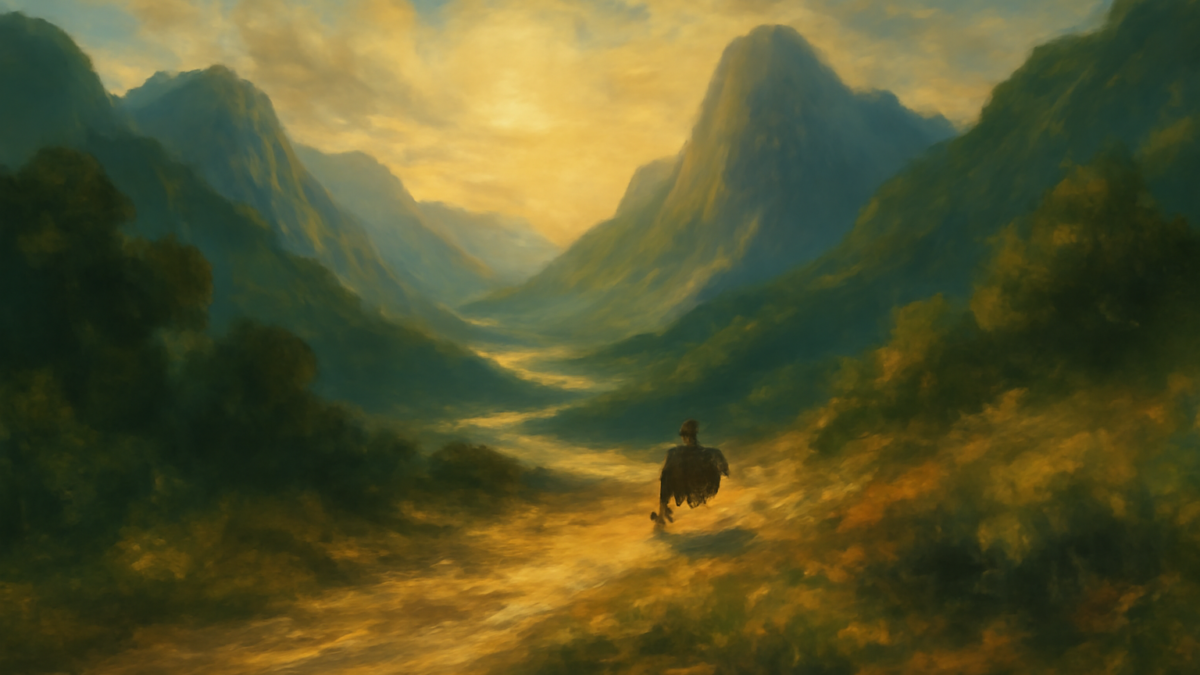
The Timeless Wisdom of Lao Tzu’s Patient Progress
The ancient Chinese philosopher Lao Tzu, whose name literally means “the Old Master,” remains one of history’s most enigmatic and influential thinkers, despite the profound obscurity that surrounds his actual life. Most scholars believe he lived during the sixth century BCE, though some accounts place him in the fourth century, making even his historical existence a matter of scholarly debate. What we know of Lao Tzu comes primarily from legend and the text attributed to him: the Daodejing, or “The Way and Its Virtue,” one of the most translated and quoted works of Chinese philosophy. According to traditional biography, he served as the keeper of records for the Zhou Dynasty before growing disillusioned with court life and deciding to leave civilization behind. When he reached the western border, a gatekeeper named Yin Xi asked him to record his teachings before departing into obscurity. This request supposedly resulted in the eighty-one short chapters of the Daodejing, though modern scholars debate whether Lao Tzu was a historical figure or a composite character representing ancient Daoist thought.
The quote “Nature does not hurry, yet everything is accomplished” emerges from the Daodejing, though it should be noted that this particular phrasing is an interpretation by modern translators, as the original text is notoriously difficult to translate with precision. The concept it expresses lies at the heart of Daoist philosophy, which emphasizes living in harmony with the Tao, or “the Way”—the fundamental nature of reality that cannot be fully described in words. Lao Tzu’s philosophy stands in deliberate contrast to the rigid hierarchies and structured ethics of Confucianism, which dominated much of Chinese thought. Where Confucianism demanded active moral cultivation and social ritual, Daoism advocated for wu wei, often translated as “non-action” or more accurately “actionless action”—a state of effortless being where one moves in complete accord with the natural flow of the universe. This paradoxical concept suggests that the most effective action comes from a state of perfect stillness and receptivity, much like water that shapes stone through patient persistence rather than force.
To understand the context of this wisdom, one must appreciate the world in which Lao Tzu supposedly lived. The sixth century BCE was a time of tremendous upheaval in China, marked by the decline of the Zhou Dynasty and the rise of feudal states competing for power. It was an era of constant warfare, political intrigue, and social instability—not unlike our modern age in many respects. During this period of chaos, Lao Tzu offered a radically different approach to life and governance. Rather than advocating for aggressive expansion, clever political maneuvering, or the assertion of human will over nature, he suggested that the wisest path lay in understanding and working with natural principles. His philosophy implied that rulers who abandoned the pretense of control and instead allowed their kingdoms to develop organically would ultimately be more successful. This counterintuitive idea represented a profound challenge to the dominant worldview of his time and has continued to offer alternative perspectives across centuries.
One fascinating aspect of Lao Tzu’s life that most people overlook involves the biographical details provided by the Daodejing’s greatest interpreter, Zhuangzi, a later Daoist philosopher. Zhuangzi presented Lao Tzu not as a stern sage dispensing dogmatic teachings, but as a wandering master with a particular fondness for questioning and paradox. According to Zhuangzi’s accounts, Lao Tzu sometimes playfully contradicted his own teachings or presented obvious logical contradictions as profound wisdom. This approach aligned perfectly with the Daoist understanding that language itself is limited and that truth often lies beyond the reach of rational explanation. Additionally, scholars have discovered that the Daodejing contains layers of meaning that vary depending on how one punctuates the classical Chinese characters—a feature that may have been intentional, allowing different interpretations to coexist. This linguistic ambiguity reflects the very nature of the Tao itself, which the text explicitly states cannot be named or fully comprehended through intellect alone.
The cultural impact of Lao Tzu’s philosophy has been remarkably durable and far-reaching, particularly in modern Western contexts where it has been embraced enthusiastically despite—or perhaps because of—initial incomprehension. The Daodejing became increasingly popular in the West during the twentieth century, particularly among counterculture movements that rebelled against industrial capitalism and rigid social structures. Beat Generation writers like Jack Kerouac and Gary Snyder drew heavily on Daoist philosophy, seeing in it validation for their rejection of conventionality and their emphasis on spontaneity and natural expression. Businesspeople, athletes, and artists have all found in Lao Tzu’s teachings guidance for their respective fields. The phrase about nature not hurrying has been quoted in contexts ranging from wellness blogs to corporate leadership seminars, sometimes to ironic effect when it appears in materials designed to maximize efficiency and productivity—a fitting contradiction that Lao Tzu himself might have appreciated.
The specific quote’s resonance lies partly in its apparent simplicity masking profound depth. In our hyperactive, deadline-driven contemporary world, the suggestion that nature accomplishes everything without haste speaks to a deep longing many people feel for a slower, more sustainable way of living. The statement also offers a subtle challenge to the achievement-