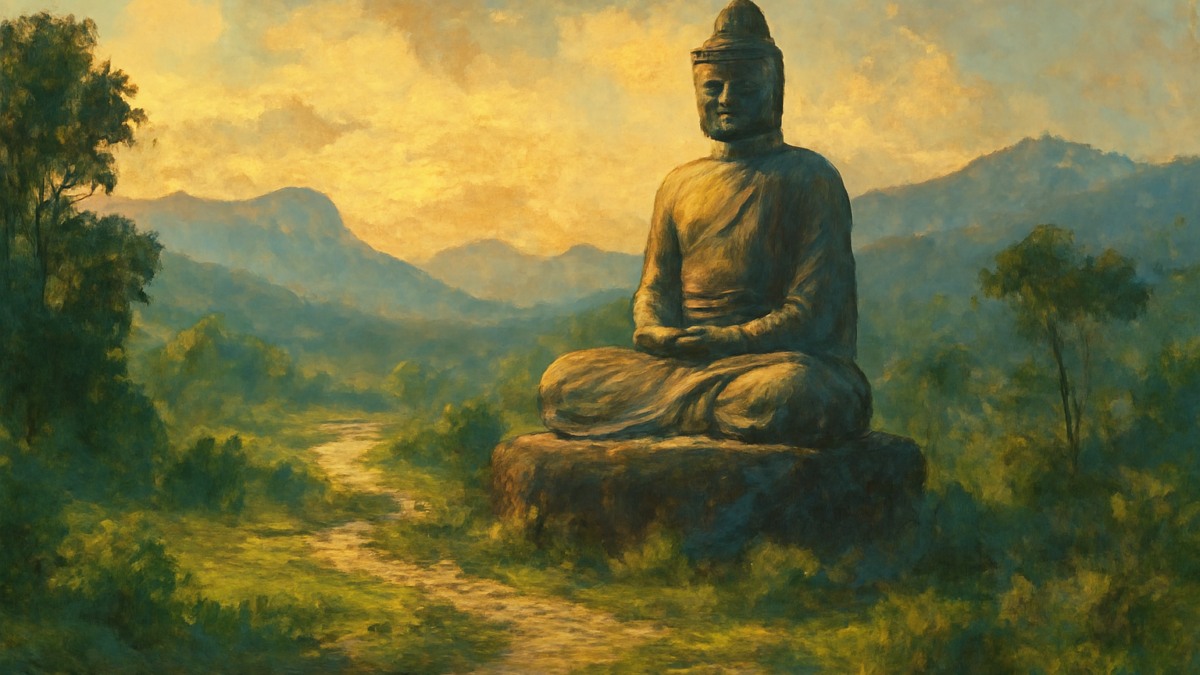
Buddha’s Path of Self-Reliance: A Journey Through History and Meaning
The quote “No one saves us but ourselves. No one can and no one may. We ourselves must walk the path” encapsulates one of Buddhism’s most revolutionary insights, yet it is often misunderstood as a message of pure individualism in the Western sense. These words are believed to come from the Dhammapada, a collection of 423 verses attributed to Buddha that were compiled centuries after his death, making the exact historical context difficult to pinpoint with precision. However, the sentiment reflects teachings that Siddhartha Gautama, who became known as Buddha, repeatedly emphasized throughout his life—that enlightenment and liberation from suffering cannot be granted by any external force, deity, or authority figure, but must be realized through one’s own insight and effort. This was a radical departure from the religious orthodoxy of sixth-century BCE India, where brahmanical traditions taught that salvation came through priest-mediated rituals, caste status, and divine intervention. Buddha’s assertion that each individual possessed the capacity and responsibility for their own spiritual transformation challenged the entire power structure of organized religion in his time.
Siddhartha Gautama was born around 563 BCE in Lumbini, in what is now Nepal, into the Shakya clan as a prince of considerable privilege. His father, King Suddhodana, carefully insulated him from suffering, surrounding him with luxury, beauty, and every conceivable comfort within palace walls. Yet at approximately twenty-nine years old, Siddhartha ventured beyond the palace and encountered the Four Sights—an elderly person, a sick person, a corpse, and an ascetic—which catalyzed an existential crisis. Confronted with the universal reality of aging, sickness, and death, he abandoned his position as heir to the throne, left behind his wife Yashodhara and infant son Rahula, and embarked on a spiritual quest that would consume the next six years. He initially pursued extreme asceticism, starving himself and engaging in rigorous self-mortification practices alongside other renunciates, nearly destroying his body in the process. However, this path proved no more effective than his former indulgence, leading him to develop what he called the Middle Way—a balanced approach between excess and deprivation.
The turning point came when Siddhartha sat beneath a Bodhi tree in Bodh Gaya, determined not to rise until he achieved enlightenment. After forty-nine days of meditation, he experienced a profound awakening to the nature of suffering and its cessation, becoming Buddha—”the Awakened One” or “the Enlightened One.” What made this experience revolutionary was his immediate recognition that this wisdom was not revealed to him by any divine being or transmitted from any external source. Rather, it emerged from his own rigorous investigation into the nature of his mind and reality. When he began teaching, Buddha consistently emphasized this principle: he presented himself not as a savior or avatar of a deity, but as a fellow traveler who had discovered the path and could offer guidance. He famously instructed his followers to “come and see” for themselves rather than accept his teachings on faith alone, saying, “Do not believe in anything simply because I have said it.” This pedagogical approach, which privileges direct personal experience over blind faith, remains one of Buddhism’s defining characteristics.
A lesser-known aspect of Buddha’s life is his remarkable pragmatism and reluctance to engage in metaphysical speculation. When disciples pressed him with questions about the origin of the universe, the nature of the soul, or whether the world was eternal or finite, he famously refused to answer, comparing these inquiries to a man shot by a poisoned arrow who insists on knowing the archer’s family history before accepting treatment. He understood that such abstract philosophical debates, while intellectually interesting, distracted from the practical work of liberation from suffering. This pragmatic orientation shaped his entire teaching method and explains why the quote about self-salvation resonated so powerfully—it was not an abstract philosophical principle but a direct practical instruction. He was telling his followers that spiritual growth required their own active participation, their own meditation practice, their own ethical discipline. No teacher, no ritual, and no prayer to the gods could do this work for them. This democratization of spiritual achievement was genuinely radical in the context of ancient India, where salvation was typically understood as the prerogative of brahmin priests or those of higher castes.
The cultural impact of this teaching extended far beyond Buddha’s lifetime and shaped the development of all Buddhist traditions across Asia. In Theravada Buddhism, predominant in Southeast Asia, the emphasis on individual effort and personal responsibility became even more pronounced, with monks and serious practitioners expected to undertake rigorous meditation and study independently. In Mahayana Buddhism, which developed later and spread across East Asia, the quote’s implications were reinterpreted somewhat through the development of the bodhisattva ideal—compassionate beings who vow to help all sentient creatures achieve liberation—yet even here, the fundamental principle remained that each being must ultimately walk their own path to enlightenment. The quote has been invoked in countless Buddhist texts, sermon collections, and philosophical treatises for over two thousand years, becoming almost synonymous with Buddhism’s core message about human agency and responsibility. In the modern Western context, it has been cited by spiritual teachers, motivational speakers, and self-help authors, sometimes emphasizing the individualistic element in ways that might have troubled Buddha himself, who placed equal emphasis on community, ethical conduct, and interdependence