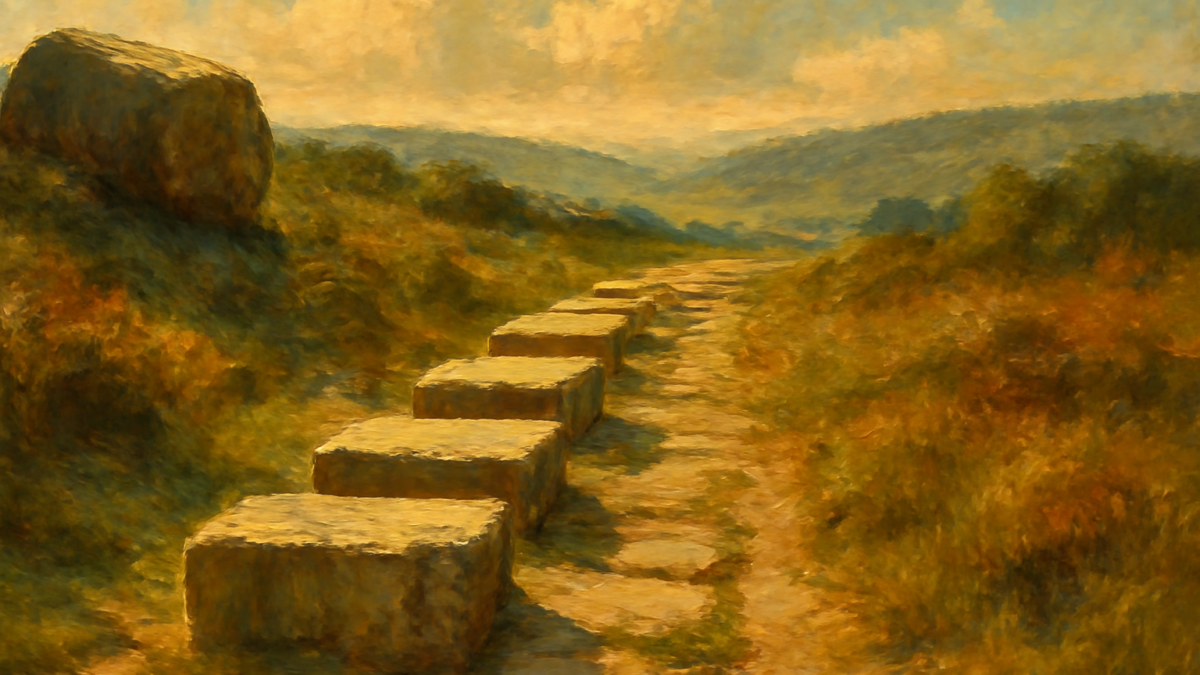
Thomas Carlyle and the Granite Stone of Strength
Thomas Carlyle, the Scottish historian, philosopher, and social critic, offered this striking metaphor about obstacles and human character sometime during the nineteenth century, though the precise moment of its utterance remains difficult to pin down with absolute certainty. The quote captures the essence of Carlyle’s broader philosophy about the role of great individuals in history and the transformative power of human will. Carlyle, who lived from 1795 to 1881, was one of the most influential intellectual figures of Victorian England, though his ideas were often provocative and his public persona somewhat prickly. He wrote extensively on history, literature, and social reform, and this particular observation about obstacles reflects his conviction that character and determination, rather than circumstance, determine the course of human lives.
To understand this quote fully, one must appreciate Carlyle’s background and the formative experiences that shaped his worldview. Born in the small village of Ecclefechan in Dumfriesshire, Scotland, Carlyle grew up in a austere household marked by religious intensity and intellectual rigor. His father was a stonemason and stern disciplinarian, while his mother embodied a Protestant work ethic that would influence young Thomas profoundly. Carlyle was educated at Edinburgh University, where he studied mathematics and classics, eventually qualifying as a teacher. However, his real education came through voracious reading and self-directed study—a fact he emphasized throughout his life. This unconventional path to intellectual authority, combined with his working-class Scottish origins, gave Carlyle a unique perspective on how individuals overcome obstacles through will and determination rather than inherited privilege or formal structures.
Carlyle’s philosophy was deeply influenced by German idealism, particularly the works of Johann Wolfgang von Goethe, whom he greatly admired and whose biography he wrote. He also drew inspiration from Johann Gottfried Herder’s ideas about historical development and the role of exceptional individuals in driving human progress. This philosophical framework led Carlyle to his most famous contribution to historical thought: the “Great Man Theory,” the idea that history is shaped primarily by the actions and ideas of exceptional individuals rather than by impersonal forces or social structures. This concept, which he expounded in his 1840 work “Heroes, Hero-Worship, and the Heroic in History,” directly informs the quote about the granite block. For Carlyle, the difference between weakness and strength was fundamentally about the quality of one’s character and the force of one’s will—the weak succumb to obstacles, while the strong transmute them into opportunities for advancement.
One of the most fascinating but lesser-known aspects of Carlyle’s life was his deeply troubled marriage to the witty and intellectually formidable Jane Baillie Welsh. They married in 1826, and while both were brilliant, their marriage was marked by considerable tension and unhappiness. Jane was an accomplished writer and thinker in her own right, yet Victorian society prevented her from pursuing a public intellectual career, a frustration that occasionally manifested in their correspondence and mutual recriminations. After Jane’s death in 1866, Carlyle experienced profound remorse about the marriage, and her posthumously published letters and journals revealed a woman of considerable suffering and unfulfilled potential. This domestic reality starkly contrasted with Carlyle’s public persona as a sage dispensing wisdom about strength and determination, suggesting that even this great man of letters struggled to translate his philosophical ideals into personal relationships. Few of his admirers recognized this irony in his life.
Carlyle was also famous for his extraordinarily difficult temperament. He was cantankerous, prone to hypochondria, and often expressed his views with a caustic venom that made him enemies among the London literary establishment. He could be simultaneously arrogant and insecure, domineering in conversation yet anxious about his influence. He suffered from chronic indigestion and nervous complaints, which he attributed partly to the stress of writing and partly to his wife’s temperament—a convenient explanation that conveniently absolved him of responsibility. Despite these personal failings, or perhaps because of them, Carlyle commanded immense respect and influence. His historical works, including “The French Revolution” (1837) and “Frederick the Great” (1858-1865), were considered monumental achievements, and his essays on society and culture were widely read and debated.
The quote about the granite block became particularly resonant during the industrial and imperial expansion of the nineteenth century, when Carlyle’s ideas about strength, determination, and individual genius aligned well with Victorian ideology and the optimistic narrative of progress through individual enterprise. The image of the granite block—solid, unyielding, seemingly immovable—served as a perfect metaphor for the industrial age’s challenges, and Carlyle’s assertion that strength could transmute obstacles into stepping-stones resonated with entrepreneurs, industrialists, and ambitious individuals who were reshaping society. The quote has been extensively reproduced in motivational literature, self-help books, and business manuals, where it functions as encouragement to view setbacks as opportunities. However, this popular appropriation often strips away the darker implications of Carlyle’s philosophy, which included his contempt for the weak, his skepticism about democracy, and his vision of hierarchical society organized around great men and their followers.
Over the past century and a half, the quote has acquired layers of meaning well beyond Carlyle’s original intention. In the context of the self-help movement that emerged in the early twentieth century, it became a touchstone for positive thinking and resil