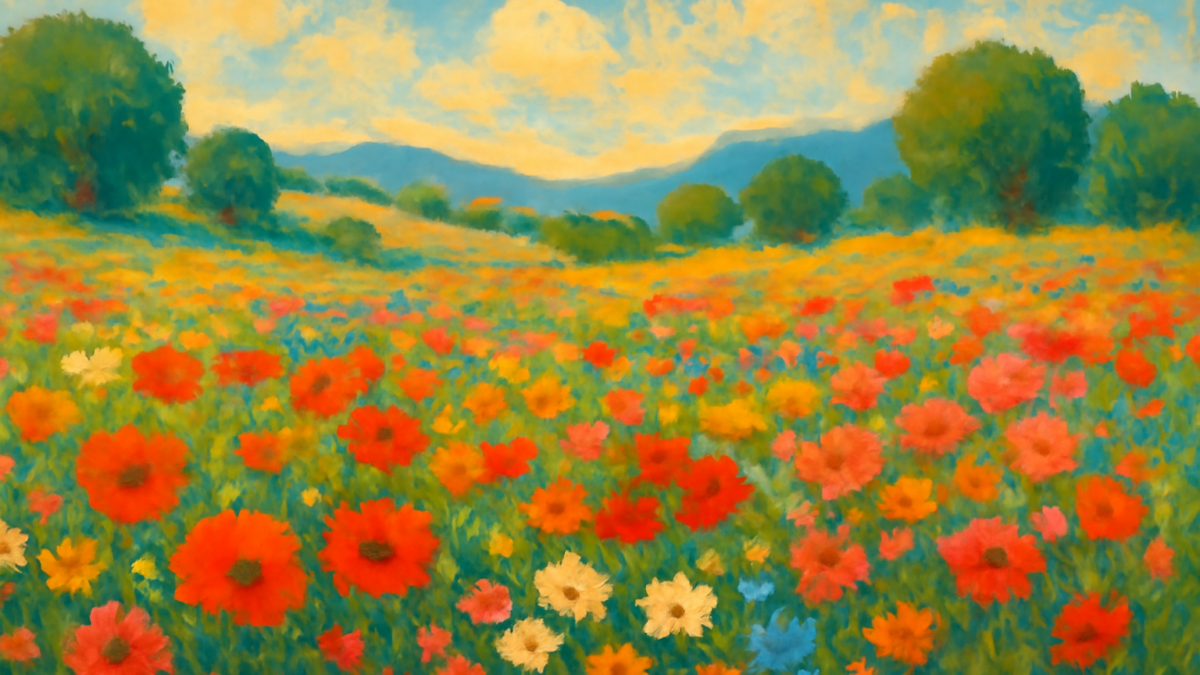
The Blossoming Vision of Henri Matisse
Henri Matisse (1869–1954) stands as one of the twentieth century’s most revolutionary artists, yet his journey to artistic mastery was far from predetermined. Born in the industrial town of Le Cateau-Cambrésis in northern France, Matisse initially studied law in Paris, following a respectable but uninspired path that his family had envisioned for him. However, a turning point arrived at age twenty-two when his mother, attempting to distract him during a period of illness, gave him a box of paints. This simple gesture awakened something profound within him. Matisse abandoned his legal studies and enrolled at the École des Beaux-Arts, beginning an artistic odyssey that would ultimately reshape modern art and establish him as the founder of Fauvism, a movement characterized by bold colors, simplified forms, and emotional directness that shocked the conservative art establishment of early 1900s France.
The quote “There are always flowers for those who want to see them” emerged from Matisse’s mature philosophy, likely formulated in his later years when he had achieved substantial recognition yet remained philosophically contemplative about the nature of perception and artistic vision. It reflects a worldview shaped by decades of intimate observation of natural forms, color relationships, and the transformative power of seeing with deliberate attention. Matisse was not a casual observer of nature; he was a dedicated student of flowers, fruits, and botanical forms that appeared repeatedly throughout his paintings, paper cutouts, and decorative designs. His studio walls were often filled with flowering plants, and he maintained a practice of sketching directly from live subjects, understanding flowers not merely as aesthetic objects but as fundamental expressions of living form and color harmony.
What many people don’t realize about Matisse is how remarkably late his most celebrated innovations came. While he was creating revolutionary paintings in his thirties and forties, it was not until his sixties and seventies—after a serious abdominal surgery in 1941 that severely limited his physical mobility—that he developed gouache découpée, or cut paper collage, a technique that many consider his most original contribution to art. Confined to a wheelchair or bed, Matisse began cutting shapes directly from pre-painted papers, creating massive, joyful compositions that demonstrated that age and physical limitation need not diminish creative power. This late flowering of his artistic practice made his philosophy about seeing and finding beauty especially meaningful. He was quite literally proving that perception, imagination, and artistic vision could transcend physical constraints, and that beauty could be accessed through whatever means remained available to an artist’s mind and spirit.
The historical context surrounding this quote relates to the broader twentieth-century artistic debate about abstraction, representation, and the purpose of art itself. During the 1930s and 1940s, as modernism fragmented into competing movements—Surrealism, Cubism, Abstract Expressionism—Matisse maintained a unique position. He rejected pure abstraction, insisting on maintaining a connection to the observable world, particularly to the sensory richness of color and form found in nature. His statement about flowers speaks directly to this commitment: he believed art’s purpose was not to escape reality or deconstruct it, but to heighten our perception of the world as it actually exists. In this sense, the quote represents a philosophical stance against the notion that art must become increasingly abstract or intellectualized to remain modern and relevant. Instead, Matisse argues for a kind of democratic access to beauty—the flowers are always there, available to anyone willing to truly look.
The quote has resonated particularly powerfully in our contemporary moment, where many people experience what psychologists term “nature deficit disorder,” spending increasing portions of their lives in digital environments disconnected from direct sensory experience. In the age of social media and filtered images, Matisse’s insistence on direct, attentive seeing feels almost subversive. The quote has been adopted by wellness practitioners, mindfulness advocates, and environmental educators as an argument for the importance of present-moment awareness and the cultivation of what might be called “perceptual gratitude.” It appears frequently in self-help contexts and inspirational spaces, sometimes reduced to a simple reminder to “look around you,” though this popularization occasionally strips away the sophisticated philosophy Matisse embedded within it.
What Matisse actually meant was more nuanced than a simple call for optimism or positive thinking. His statement was fundamentally about the relationship between intention and perception, suggesting that what we see in the world is partly determined by the quality of attention we bring to observation. For Matisse, the flowers were not metaphors for hidden goodness—they were actual flowers, available in their full chromatic and formal complexity to anyone who approached them with what we might call an artist’s eye. This perspective emerged from his extensive travels, particularly to Morocco, Tahiti, and the Côte d’Azur, where exposure to intense light, vivid colors, and Mediterranean vegetation had deeply influenced his palette and approach. The flowers in his paintings and paper cutouts were not idealized fantasies but distilled essences of flowers he had actually observed, their forms and colors intensified through artistic concentration.
The practical implications of Matisse’s philosophy extend far beyond art galleries and museum walls. The quote challenges a pervasive modern assumption that beauty and inspiration must be artificially created or purchased, downloaded or consumed. Instead, it asserts that the natural world contains perpetual sources of delight and interest for those who develop the capacity to perceive them. This has become increasingly relevant in discussions about mental health and environmental consciousness. Scientific research increasingly demonstrates