Maya Angelou and the Rainbow in Someone’s Cloud
Maya Angelou, born Marguerite Ann Johnson on April 4, 1928, in St. Louis, Missouri, became one of the most influential writers and civil rights activists of the twentieth century. Her remarkable journey from a traumatized child to an internationally celebrated author, poet, and speaker is the foundation upon which her most memorable wisdom rests. The quote “Try to be a rainbow in someone’s cloud” encapsulates the compassionate humanism that defined her life’s work and personal philosophy. This seemingly simple statement reveals the complexity of Angelou’s thinking: the acknowledgment that life contains storms and suffering, paired with an unwavering belief in humanity’s capacity to bring light and beauty to one another. To fully understand this quote, one must first understand the woman who spoke it and the extraordinary circumstances that shaped her voice.
Angelou’s early life was marked by trauma and silence. After being raped at age eight by her mother’s boyfriend, she stopped speaking for nearly five years, a period of mutism that profoundly shaped her understanding of language and communication. During this silent period, she developed an exceptional memory and became voraciously literate, reading everything from Shakespeare to African American folklore. This forced introspection and isolation, rather than breaking her spirit, became a crucible that refined her empathy and deepened her ability to see into the hearts of others. She emerged from her silence with an intense appreciation for words and their power to heal, transform, and illuminate human experience. This personal crucible directly informed her later work as a healer and advocate, making her understanding of human suffering not theoretical but deeply, intimately felt.
The context in which Angelou developed and shared this particular quote must be understood within the broader arc of her career as a civil rights activist, educator, and mentor. Throughout the 1960s, 1970s, and beyond, Angelou worked tirelessly to support the Civil Rights Movement, collaborating with figures like Malcolm X and Martin Luther King Jr. She understood from her own experience that oppression and injustice created clouds of darkness over entire communities. Her famous autobiography “I Know Why the Caged Bird Sings,” published in 1969, became a watershed moment in American literature, breaking silences about racism, trauma, and resilience. The quote about being a rainbow in someone’s cloud emerged from this period of active social engagement, when Angelou was simultaneously processing her own painful history and working to address systemic injustice. She spoke these words to audiences struggling with racism, poverty, and personal devastation, offering them not naive optimism but hard-won wisdom about how human beings sustain each other.
What many people don’t realize about Angelou is the breadth of her professional accomplishments beyond writing. She was a trained dancer and performer, having worked in theater and as a calypso singer in the 1950s. She served as the coordinator for the Southern Christian Leadership Conference and worked as a journalist reporting on the Middle East. She lived abroad in Egypt and Ghana, gaining international perspective on human struggle and resilience. She earned over fifty honorary doctorates and served as a professor at Wake Forest University for fifteen years. Her Nobel Prize nomination, multiple Grammy Awards, and recognition as a National Medal of Arts recipient reflected her status as a cultural icon. What’s particularly lesser-known is her spiritual eclecticism—Angelou practiced Buddhism, Christianity, and other spiritual traditions, always seeking wisdom across boundaries of faith and culture. This openness to multiple perspectives made her uniquely equipped to speak to diverse audiences about universal human needs.
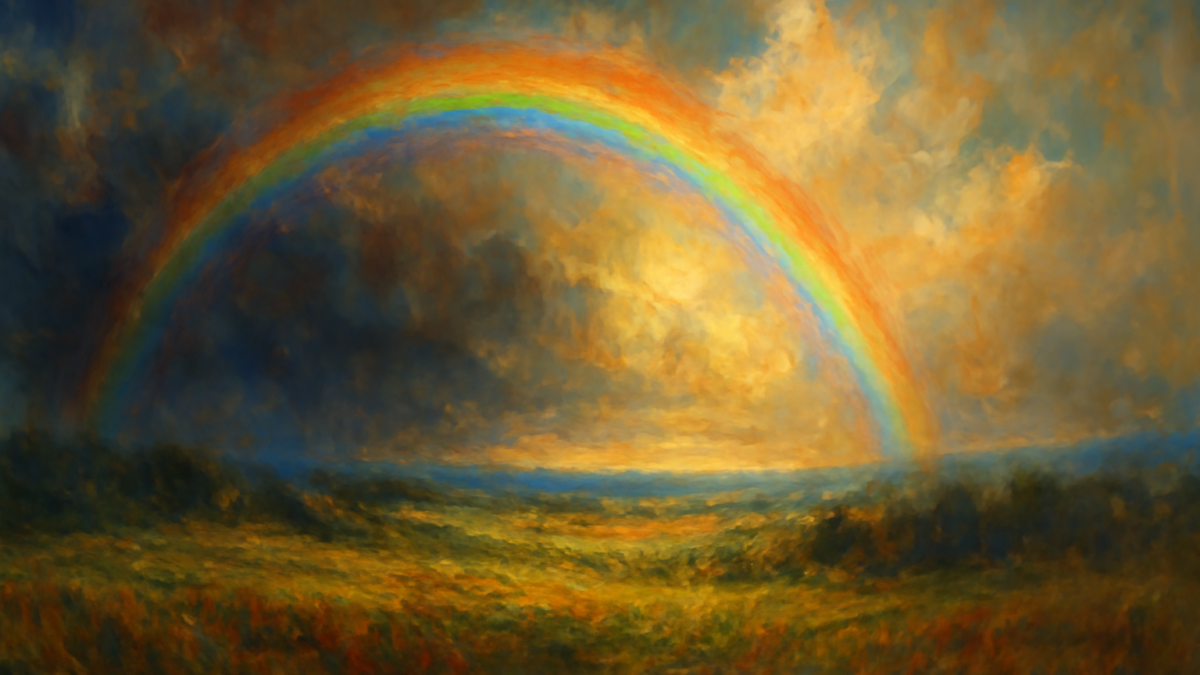
The specific phrasing of “Try to be a rainbow in someone’s cloud” reveals Angelou’s sophisticated understanding of both meteorology and metaphor. A rainbow appears precisely because of rain—it requires the cloud and the suffering it represents. The rainbow doesn’t deny the storm; it exists because of the storm’s presence. This is fundamentally different from toxic positivity, which insists that suffering doesn’t exist or should be ignored. Angelou’s advice to “try” rather than “be” also matters; the word acknowledges that this goal requires effort and intention, that goodness is not passive but actively chosen. The phrase combines realism about human difficulty with an assertion that light and beauty can coexist with hardship. This nuanced wisdom emerged from a woman who had experienced unspeakable pain but refused to let that pain have the final word in defining her life or limiting her service to others.
Over the decades since Angelou first articulated this philosophy, the quote has become deeply woven into contemporary culture, appearing on social media, in graduation speeches, on motivational posters, and in countless personal journals. Its cultural impact lies in its accessibility paired with its depth—it can comfort someone on their darkest day while also inspiring long-term commitment to service and kindness. The quote has been quoted at funerals as a way of honoring lives lived in service to others, and at celebrations of people who embodied Angelou’s vision of radical compassion. Teachers have used it to reframe how students think about their role in their communities. Activists have invoked it as a reminder that personal kindness and systemic change are not opposed but complementary. The phrase has transcended the category of inspirational quote to become something closer to a cultural touchstone, a shared language for talking about how to live meaningfully in a difficult world.
What makes this quote resonate so powerfully in everyday life is its simultaneous acknowledgment of reality and hope. People don’t need to be told that the world contains clouds—they experience rain and darkness regularly. What