
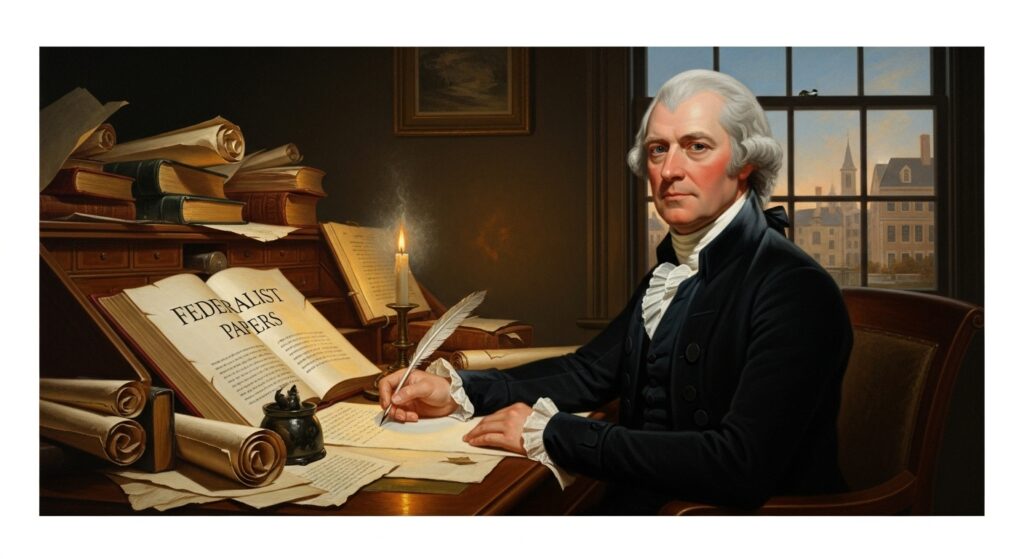
James Madison, one of America’s key Founding Fathers, left behind a wealth of political wisdom. One of his most enduring warnings comes from a simple, yet profound, observation. This profound insight stems from Madison’s rigorous study of history, philosophy, and the inherent imperfections of human governance. He understood that the grand experiment of self-government would perpetually contend with the ebb and flow of human virtue and vice. The “core truth” he articulated was not merely that bad leaders might emerge, but that they inevitably would. Human ambition, self-interest, susceptibility to factionalism, and the corrupting influence of power were, to Madison, undeniable realities, not theoretical possibilities.
His “call for realism” was a rejection of idealistic visions that posited a populace or a leadership class inherently capable of unwavering altruism. Madison had witnessed firsthand the failures of the Articles of Confederation, where state legislatures, often swayed by parochial interests and popular passions, demonstrated a disturbing capacity for shortsightedness and injustice. He observed how even well-intentioned leaders could be overwhelmed by the demands of their constituents or succumb to the temptations of demagoguery. This historical evidence, coupled with his deep engagement with thinkers like Hume, Locke, and Montesquieu, solidified his conviction that a republic’s survival could not be predicated on the consistent presence of “enlightened statesmen” – those paragons of wisdom, integrity, and public spiritedness.
Instead, Madison’s genius lay in designing a framework that anticipated and counteracted these human failings. He wasn’t naive enough to believe that a perfect system could eliminate imperfect leaders, but he was brilliant enough to devise one that could contain their potential for harm. His vision centered on creating a government “strong enough to survive imperfect ones” by embedding structural safeguards. This meant advocating for a system of checks and balances, where ambition would be made to counteract ambition, and where no single branch or individual could accumulate unchecked power. The separation of powers, the bicameral legislature, an independent judiciary, and the executive veto were not just theoretical constructs; they were practical bulwarks against the inevitable rise of less-than-ideal leadership. Furthermore, the concept of an extended republic, as articulated in Federalist No. 10, aimed to dilute the power of any single faction by encompassing a multiplicity of interests, making it harder for a charismatic but destructive leader to seize control. The very structure of the Constitution, with its emphasis on deliberation, accountability through elections, and a supreme rule of law, was Madison’s pragmatic answer to the enduring problem of human imperfection at the helm of power.
The Man Behind the Words
Madison’s intellectual journey began in earnest at the College of New Jersey (later Princeton University), where under the tutelage of President John Witherspoon, a prominent figure of the Scottish Enlightenment, he immersed himself in a rigorous curriculum spanning classical languages, philosophy, ethics, and political theory. This formal education was merely a springboard. Upon graduating, and amidst the burgeoning American Revolution, Madison retreated to his family home in Orange County, Virginia, embarking on an intensive, self-directed course of study that would define his political philosophy.
He meticulously compiled extensive notes and summaries from an impressive array of sources, creating a personal encyclopedia of governmental structures and historical precedents. His reading list was prodigious, encompassing the Enlightenment giants like John Locke, whose theories on natural rights and social contract profoundly influenced him; Baron de Montesquieu, whose ideas on the separation of powers and the spirit of laws provided critical architectural blueprints; and David Hume, whose essays on human nature and the stability of government offered pragmatic insights. Beyond these modern thinkers, Madison delved deeply into the annals of antiquity. He scrutinized the works of Polybius, analyzing the mixed constitution of Rome; he studied Livy’s detailed accounts of the Roman Republic’s triumphs and eventual decline; and he examined the Greek city-states, dissecting the successes and failures of their various leagues and confederacies, such as the Amphictyonic and Achaean Leagues. From these historical laboratories, he observed recurring patterns: the perils of pure democracy leading to mob rule, the dangers of factionalism tearing societies apart, the inherent weaknesses of confederations lacking strong central authority, and the cyclical nature of power corrupting even the noblest intentions.
This exhaustive intellectual preparation culminated in two crucial documents prior to the Constitutional Convention: his “Vices of the Political System of the United States,” a scathing indictment of the Articles of Confederation, and his “Notes on Ancient and Modern Confederacies,” a compendium of historical lessons on governmental structures. Armed with this unparalleled understanding of both theoretical principles and practical historical outcomes, Madison arrived in Philadelphia in 1787 not merely as a delegate, but as the most thoroughly prepared and articulate advocate for a new form of government. His erudition allowed him to frame the debates, guiding his fellow delegates away from the pitfalls of past republics and towards innovative solutions that would balance liberty with order, and popular sovereignty with stability. It was this profound, almost encyclopedic command of history and political science that enabled him to draft the fundamental framework of the Virginia Plan, serving as the foundational blueprint for the U.S. Constitution, thereby earning him the indelible title of the “Father of the Constitution.”
Long before the delegates convened in Philadelphia, James Madison had embarked on a rigorous intellectual journey, meticulously preparing himself for the monumental task of constitutional reform. His extensive studies delved deep into the annals of history, examining the rise and fall of ancient confederacies and modern republics, dissecting their strengths and, more importantly, their fatal flaws. He corresponded voluminously with leading thinkers of his era, like Thomas Jefferson, exchanging ideas and refining his own. This intense academic preparation culminated in his influential memorandum, “Vices of the Political System of the United States,” a comprehensive critique of the existing government that laid bare the fundamental weaknesses he intended to address.
Madison’s analysis confirmed that the Articles of Confederation, born of revolutionary-era distrust of centralized power, had indeed proven inadequate to the challenges of nation-building. The fledgling republic was dangerously fragmented, a mere “league of friendship” rather than a cohesive entity. States engaged in destructive economic rivalries, erecting trade barriers against one another and issuing their own depreciated currencies, plunging the national economy into chaos. Lacking any real power to tax or enforce its laws, the Confederation Congress was a supplicant, unable to fund a national army, respond effectively to domestic insurrections like Shays’ Rebellion, or command respect on the international stage. The specter of anarchy loomed large, threatening to unravel the hard-won independence.
It was this grim reality that cemented Madison’s conviction that the nation could no longer afford to stake its future on the mere hope that good intentions or the inherent virtue of its citizens and leaders would suffice. He recognized that human nature, while capable of great good, was also prone to self-interest, ambition, and factionalism—forces that, left unchecked, could easily undermine any political system. His proposed solution, therefore, was a sophisticated governmental architecture designed not for a utopian society, but for a world populated by imperfect individuals. This framework sought to harness these inherent human tendencies through a system of checks and balances, separation of powers, and an extended republic, ensuring that no single branch, faction, or even a majority could tyrannize the whole. He understood that relying solely on the consistent presence of “enlightened statesmen” at the helm was a perilous gamble; the system itself had to be robust enough to channel self-interest for the common good and withstand periods when less virtuous or more partisan individuals inevitably rose to power. The Constitution, in his vision, would be a testament to a pragmatic realism, safeguarding liberty and stability through institutional design, rather than through an overly optimistic faith in human perfectibility.
Madison’s intellectual prowess was legendary among his peers, rooted in an almost encyclopedic command of history, political theory, and law. His meticulous preparation for the Constitutional Convention, famously documented in his “Vices of the Political System” and his exhaustive “Notes on the Debates,” revealed a mind not only brilliant but uncommonly disciplined in its pursuit of understanding and solutions. While he lacked the thundering rhetoric of a Patrick Henry or the charismatic presence of an Alexander Hamilton, Madison’s influence emanated from the sheer force of his logic and the intricate scaffolding of his proposals. He didn’t persuade through oratorical flourish, but through irrefutable reason, carefully marshaled evidence, and a deep understanding of constitutional mechanics. It was his Virginia Plan, though formally presented by Edmund Randolph, that fundamentally shaped the Convention’s agenda, outlining a powerful national government meticulously balanced through a bicameral legislature, an independent executive, and a judiciary—a comprehensive blueprint for a truly federal republic.
This profound understanding of governmental architecture stemmed not from a cynical view of human nature, but from a pragmatic and deeply informed skepticism regarding the concentration and exercise of power. He wasn’t dismissive of the possibility of virtuous leadership, but he grasped the immutable truth that “enlightened statesmen will not always be at the helm.” His wisdom was forged in the crucible of historical study, from the tragic cycles of ancient republics—where factionalism and demagoguery invariably led to tyranny or anarchy—to the more recent failures of the Articles of Confederation, which demonstrated the perils of unchecked state power and a weak central authority. Madison recognized that institutions, not just individuals, must be designed to contain ambition, channel self-interest, and prevent the inevitable abuses that arise when power is left untethered. This practical realism, rather than a jaded outlook, drove his relentless pursuit of a constitutional framework defined by separation of powers, checks and balances, and federalism—ingenious safeguards against the very human frailties he so acutely understood.
The Context: A Nation on the Brink
To truly grasp Madison’s quote, we must understand the crisis that produced it. After the Revolutionary War, the United States was less a nation and more a loose league of states. The central government under the Articles of Confederation couldn’t collect taxes, regulate commerce, or field a proper army. States bickered over borders and trade, and the national economy was in shambles.

This instability led to the creation of the Federalist Papers. Written by Madison, Alexander Hamilton, and John Jay, these 85 essays were a public relations campaign. They argued in favor of ratifying the new, more powerful Constitution. It was within this high-stakes debate that Madison penned his famous warning.
Federalist No. 10: The Danger of Factions
Madison’s quote appears in Federalist No. 10, one of the most celebrated essays in the collection. The entire paper is a masterclass on the dangers of “factions.” Today, we might call them spe
Learn More About This Historical Period
To deepen your understanding of this historical period, consider these resources:
- Inspirational Quotes: James Madison Quotes
- James Madison: A Biography
- James Madison: A Life Reconsidered
- James Madison: America’s First Politician
- The Three Lives of James Madison: Genius, Partisan, President
- James Madison
- James Madison: A Life from Beginning to End (Biographies of US Presidents)
- James Madison (The American Presidents Series)
- The Last Founding Father: James Monroe and a Nation’s Call to Greatness
- The Story of James Madison: A Historical Biography for Young Readers Ages 8-13
- The Constitutional Convention: A Narrative History from the Notes of James Madison (Modern Library Classics)
- The Mind of the Founder: Sources of the Political Thought of James Madison
As an Amazon Associate, we earn from qualifying purchases.
cial interest groups, political parties, or any group of citizens united by a common passion or interest that is at odds with the public good.
Madison argued that factions are an unavoidable part of a free society. As long as people have different opinions, amounts of property, and interests, they will form groups to advance their own causes. He wrote that trying to eliminate factions would mean destroying liberty—a cure worse than the disease.
The real challenge, he explained, was to control their effects. This is where his realism shines. He directly confronts the naive idea that good leaders will simply solve the problem:
“It is in vain to say that enlightened statesmen will be able to adjust these clashing interests, and render them all subservient to the public good. Enlightened statesmen will not always be at the helm.”
In other words, we cannot rely on the constant presence of wise and virtuous leaders to save us from ourselves. A government must have a structure that can manage conflict and prevent any single faction from trampling on the rights of others, regardless of who is in charge.
A Government for Imperfect People
Madison’s philosophy was a direct challenge to the utopian ideals of some thinkers. He believed that self-interest was a powerful and permanent motivator in human affairs. This view is famously captured in another of his writings, Federalist No. 51, where he states, “If men were angels, no government would be necessary.”
Since people are not angels, they require a government that accounts for their flaws. This meant designing a system where, as he put it, “ambition must be made to counteract ambition.” The entire structure of the U.S. Constitution is built on this principle. It was designed to function even when—not if—fallible and self-interested people held power.
This is why Madison championed a system of checks and balances. Power was deliberately divided between three branches of government: the legislative (Congress), the executive (the President), and the judicial (the Supreme Court). Each branch was given tools to limit the power of the others. A president can veto a law from Congress, but Congress can override the veto. The courts can declare a law unconstitutional, but the president appoints the judges with the Senate’s approval.
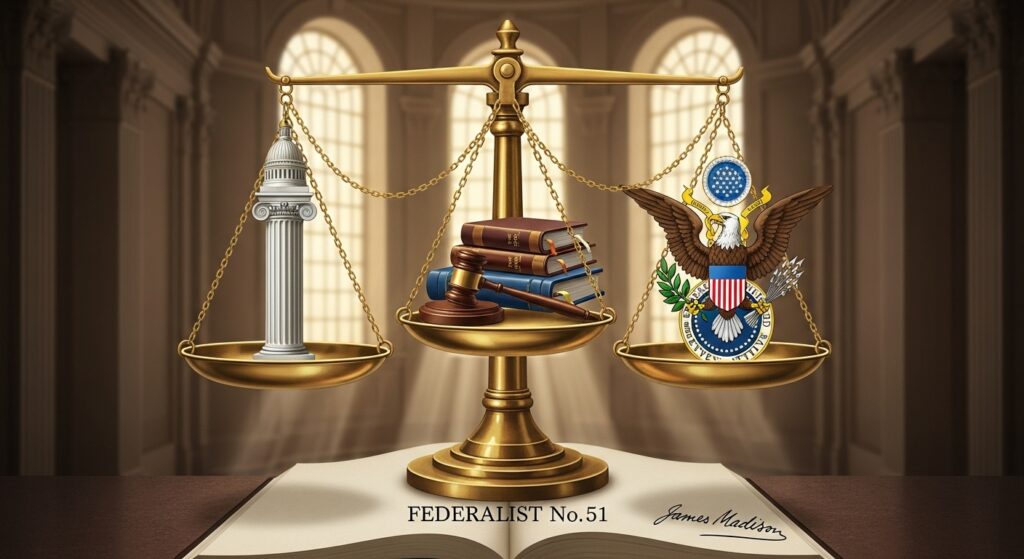
This intricate dance of power was not designed for efficiency. It was designed for safety. It slows down the political process, forcing compromise and preventing any one person or group from seizing total control. It is the architectural embodiment of Madison’s warning that we cannot count on enlightened leaders to always be in charge.
Madison’s Wisdom Today
This enduring relevance underscores Madison’s profound understanding of human nature and the inherent challenges of self-governance. The “factions” he meticulously dissected in Federalist No. 10 — groups united by a common interest adverse to the rights of others or the aggregate interests of the community — are palpably evident today. Political polarization, for instance, has metastasized beyond mere disagreement into deeply entrenched ideological divides, often characterized by an inability to find common ground or compromise. Debates over critical issues like healthcare, climate policy, or immigration reform frequently devolve into zero-sum battles, with each side viewing the other not as a loyal opposition but as an existential threat, often fueled by partisan media ecosystems and social media echo chambers that reinforce existing biases.
Similarly, the specter of intense lobbying by special interests looms large, demonstrating the relentless pursuit of narrow agendas. Well-funded corporate PACs, powerful industry associations, and single-issue advocacy groups pour vast resources into influencing legislation, regulatory decisions, and even judicial appointments. This constant pressure can distort the legislative process, prioritizing the specific gains of a few over the broader public good, creating a “revolving door” where former officials transition seamlessly into lobbying roles, leveraging their inside knowledge and connections. These dynamics illustrate Madison’s concern that powerful groups, motivated by economic self-interest or passionate conviction, would inevitably seek to sway government to their advantage, potentially at the expense of justice and the common welfare.
The heated public debates of our era, often characterized by vitriol, misinformation, and personal attacks rather than reasoned discourse, further echo Madison’s prescient warnings. While he championed free speech, he also recognized the potential for demagoguery and unbridled passion to overwhelm rational deliberation. The cacophony of online discussions, the sensationalism of cable news, and the weaponization of information can make it exceedingly difficult for citizens to discern truth from falsehood, fostering an environment where emotional appeals often triumph over evidence-based arguments, thereby hindering the informed public opinion essential for a healthy republic.
In light of these persistent challenges, Madison’s ultimate caution rings truer than ever: the long-term viability and integrity of a republican government hinge not primarily on the occasional emergence of “enlightened statesmen,” but on the robust architecture of its foundational institutions. He understood that human fallibility is a constant; leaders, no matter how well-intentioned, are susceptible to ambition, error, or corruption, and moments of virtue cannot be guaranteed. Therefore, he meticulously designed a system of checks and balances, separation of powers, federalism, and an independent judiciary precisely to mitigate the impact of individual failures. These institutional safeguards—the constitutional mechanisms that diffuse power, force compromise, protect minority rights, and provide avenues for peaceful dissent and redress—are the true bulwarks against tyranny and the undue influence of factions. It is the strength of these structures, their ability to constrain power and ensure accountability even when those at the helm are less than enlightened, that ultimately determines the republic’s resilience against the divisive forces Madison so keenly observed.
The system he helped create was built for disagreement and conflict. It assumes that leaders will not always be enlightened. By understanding the history behind his famous quote, we gain a deeper appreciation for a government designed not for a perfect world, but for the real one.